
Trialoogi toimetaja
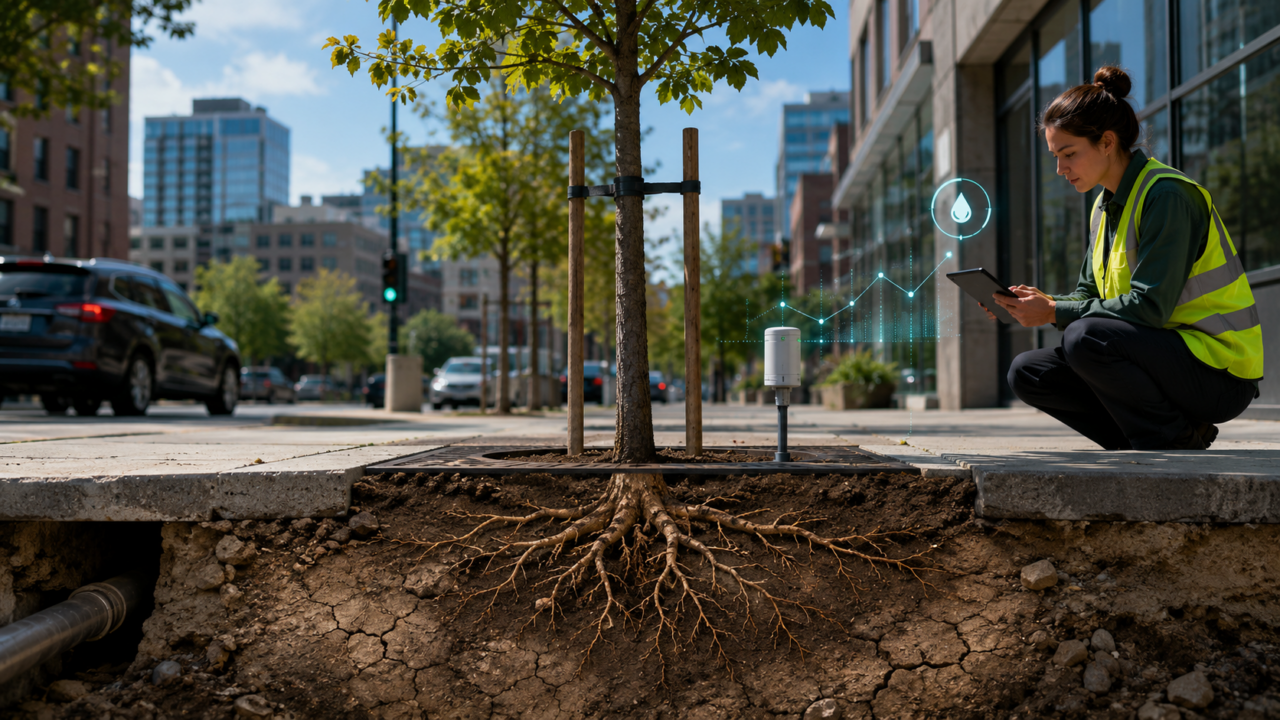
A young city tree can die long before anyone notices. Above ground, it may still look alive; below the pavement, its roots may already be struggling with dry soil, compacted ground or poor growing conditions. TalTech professor Muhammad Mahtab Alam wants to make that hidden stress visible with a sensor- and AI-based system that helps cities know when trees need water – and how to keep urban greenery alive in a changing climate.
Urban trees are expected to do a lot. They soften heat, absorb water, improve the living environment and make streets more pleasant. Yet the city is often one of the hardest places for a tree to grow. Soil is compacted, space is limited, roots compete with infrastructure, and climate change makes weather less predictable.
For Muhammad Mahtab Alam, tenured professor at TalTech’s Thomas Johann Seebeck Department of Electronics, the problem is not only that some cities face drought while others struggle with flooding. The deeper challenge is that urban greenery is still too often managed without enough real-time information. Cities may know where trees are planted, but not always how each area is actually doing below the surface.
The proposed solution „Tree Pits for Challenging Urban Conditions“ , selected as one of the finalists of the FinEst Centre for Smart Cities Smart City Challenge 2025, focuses especially on young trees. According to Alam, the first years after planting are decisive. If a tree survives the first three or four years in difficult urban conditions, it has a much better chance of becoming a strong part of the city landscape.
The tree that could speak
Alam describes the long-term vision with a deliberately simple image: a tree that can tell people what it needs. “Imagine that in the morning you are going to your office, and the tree tells you: could you give me a glass of water?” he says.

Behind that image is a practical technical idea. Sensors placed near trees would measure soil moisture and possibly other relevant indicators. The data would move into an IoT platform and then into an AI-supported decision system that helps predict which trees, areas or species need water, and when.
The point is not to make tree care more complicated, but more precise. Today, a contractor may be asked to water hundreds of trees according to a fixed schedule. In reality, some trees may urgently need water, while others may not need it at all. “The bottom line is that watering the tree needs significant improvement,” Alam says.
“Imagine that in the morning you are going to your office, and the tree tells you: could you give me a glass of water?”
The solution “Tree Pits for Challenging Urban Conditions”, selected as a finalist in the FinEst Centre for Smart Cities’ Smart City Challenge, focuses primarily on young trees. According to Alam, the first years after planting are crucial. If a tree can survive the first three to four years in challenging urban conditions, it has a much better chance of growing into a strong and lasting part of the urban landscape. Photo: Pexels
Less guesswork, better use of water
The system is not built around the idea that every tree must necessarily have its own sensor. Alam says this is exactly what the pilot should help test. In some cases, one sensor may be enough for a group of trees if the species, soil and surrounding conditions are similar. In other cases, more detailed monitoring may be needed.
This is where the project becomes more than a watering tool. By comparing species, locations and moisture conditions, cities could learn which trees survive best in which environments. That knowledge would help them make better planting decisions in the future, instead of repeatedly replacing trees that are poorly suited to a specific urban setting.
The financial side matters as much as the technical one. Sensors beside every tree would be expensive, and Alam says cities are not necessarily interested in owning more infrastructure. They are more interested in a useful service that helps them maintain trees better, save water and use contractors’ time more wisely. “Resource optimization is valid for any city. Resources are limited, and budgets are limited,” he says.
Citizens can help, but the city must still be in control
One part of the idea is citizen engagement. A future app could show residents which nearby trees need watering and allow people to help. If someone waters a tree, the system would not have to rely only on a manual update. The sensor reading would eventually show whether the soil moisture actually changed.
Alam sees this as a way to combine civic participation with municipal reliability. Some cities have already experimented with community-supported watering, but results can vary widely. People may be willing to help, but a city cannot build essential maintenance only on goodwill.
That is why the system would still remain manageable by the municipality. Citizen participation would add value, not replace professional maintenance. “We want to develop a reliable system which, on one side, gives citizens an opportunity to participate and, on the other, can be managed by cities,” Alam says. For cities facing hotter summers, heavier rain and tighter budgets, that balance may become increasingly important.
“We want to develop a reliable system which, on one side, gives citizens an opportunity to participate and, on the other, can be managed by cities.”
“Tree Pits for Challenging Urban Conditions” is currently one of the five finalists in the FinEst Centre for Smart Cities’ Smart City Challenge 2025. The next phase will be decisive: from April to August, the teams will work with cities and experts to turn their concepts into detailed pilot projects, including an action plan, budget and practical implementation model. In autumn, the projects will be evaluated once more, and two of the five finalists will be selected to receive up to €840,000 in funding. The chosen pilots are expected to start in November 2026 and run until the end of 2028.