Dean of TalTech’s School of Engineering


Estonia has a shortage of engineers, and the problem will become even more acute in the coming years. Universities can train more engineers, but increasing admissions alone is not enough. To turn today’s students into capable engineers in the labour market, universities and businesses need to work more closely as one team.
The shortage of engineers has long ceased to be merely a recruitment problem for businesses. The development of our energy, construction, industry and transport sectors, and companies’ ability to adopt new technologies, depend on engineering expertise. According to OSKA, which forecasts Estonia’s workforce needs, demand for new workers with higher education is almost 50% greater than the supply from higher education institutions. This is despite a steady improvement in completion rates in recent years. At TalTech’s School of Engineering, for example, the proportion graduating reached 58% this spring.
Recent experience shows that young people’s interest in engineering can be increased. Over two years, admissions to the School of Engineering have risen from 903 to 1,381 students. The most popular programmes illustrate this growth: 144 students began studying Building Design and Construction Management in 2024, compared with 252 this year. Electrical Power Engineering and Mechatronics attracted 120 new students in 2024 and 201 a year later. New programmes are also generating interest: Logistics and Mobility, launched for the first time this year, brought 87 learners to the university.
These figures give grounds for optimism, but also raise questions. Estonia needs not simply more engineering students, but more good engineers. Our measure of success is not whether we can barely fit young people into lecture halls in September. Above all, we must look at the knowledge and skills they leave with a few years later.
Becoming an engineer also happens outside the lecture hall or laboratory
This is where businesses play a particularly important role. We cannot build strong engineering education on a model in which the university teaches and the company waits at the gate for a fully trained employee.
Engineers learn most when solving everyday problems. This is precisely where businesses can and must make a concrete contribution to developing the next generation of engineers. A company can offer internships, identify pressing problems for course projects and graduation theses, and involve its specialists as visiting lecturers and co-supervisors. Through such practical experience, students discover direct connections between the classroom and engineering work. Encountering current problems helps them understand why they are studying something and which problems their knowledge can solve.
Employers also emphasise that university studies alone may not be enough for everyday work. Professional internships, active participation in student projects and exposure to working life support future engineers’ development. The more insight students gain into real workplace issues, the better they connect theory with practice and strengthen their competitive advantage. This also means companies can help develop a skilled workforce from students’ very first years at university.
We cannot build strong engineering education on a model in which the university teaches and the company waits at the gate for a fully trained employee.

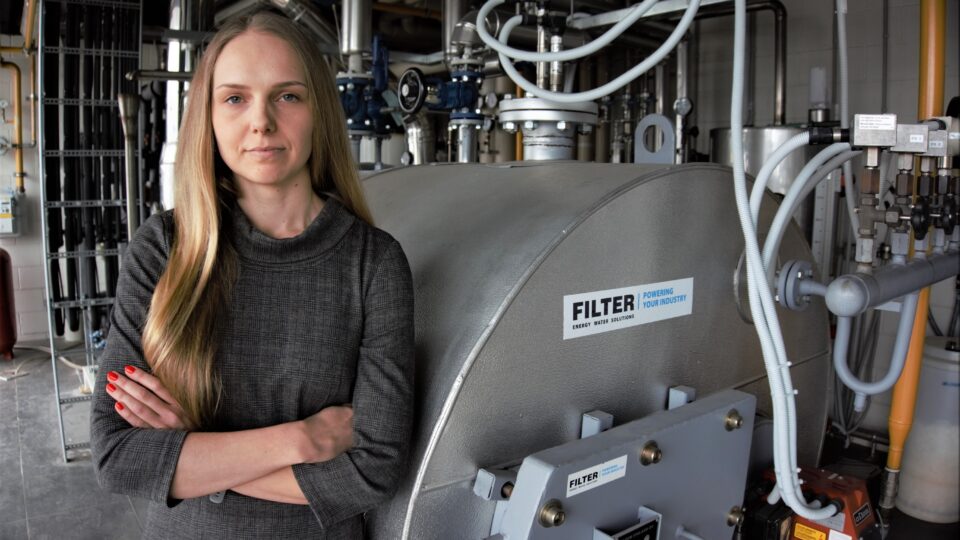
Young engineer | Photo: Harno Marek
Growing student numbers must not lower the bar
At the same time, higher admissions have posed a very practical question for the university: how can we teach significantly more students without compromising educational quality?
Through the Engineering Academy, we have updated almost a hundred courses, and more than 130 university teachers have taken part in our training. In recent years, we have also introduced teaching assistants, who help organise large study groups and laboratory work and enable more individual learning support.
We cannot compromise on quality under any circumstances. Every engineer’s decisions affect the safety of buildings and infrastructure, the reliability of energy systems and companies’ competitiveness. The shortage cannot therefore be solved by lowering requirements. On the contrary, we must give students better opportunities to meet them.
This also concerns dropping out. Engineering studies are demanding, and must remain so. But students should not leave because they cannot get help at the right time. We therefore offer first-year students additional mathematics tuition, induction programmes and more individual support, and use learning analytics to identify difficulties as early as possible. Against the backdrop of the engineering shortage, simply attracting more young people into engineering studies is not enough: we must also help them enter the labour market as good engineers.
The next generation starts before university
Interest in technical education begins long before an application is submitted. While still at school, young people need to experience engineering as much more than complicated formulae. It offers a chance to intervene directly in how the world works: building more energy-efficient buildings, automating production, developing new materials or creating the energy solutions of the future.
Through the Engineering Academy, we have therefore begun bringing engineering into general education schools more extensively. Together with the Estonian Association of Engineers, we introduce young people to a wide range of engineering disciplines and related career opportunities. At the beginning of the year, online engineering electives were developed for schools, enabling pupils to explore fields that interest them regardless of their school’s location.
The Young Engineer Programme has been a great help in recent years: 104 pupils participated in 2025, for example. More than half of those who took part over the past three years subsequently came to study at TalTech, and three quarters of those joined the School of Engineering.
Businesses can also contribute more to work with schools. It is one thing to tell young people that Estonia needs engineers. It is far more effective for an engineer in person to introduce their everyday work and explain why it matters. Better still, young people can try their hand at solving a practical task themselves.
Now is a good time to do this. Large numbers of young people will reach higher education in the coming years, and there is national recognition of the need to increase study places in fields with particularly high workforce demand. A window of opportunity has opened for a few years, and we must not miss it.
The university’s task is to be ready: to admit more motivated young people, give them a strong education and help them complete their studies successfully. Businesses have both the opportunity and the responsibility to be attentive partners to the university throughout this journey.
No single campaign, new study programme or increase in admissions will solve the shortage of engineers. A solution will emerge when schools help young people discover engineering, universities give them strong knowledge, and businesses provide opportunities to apply it to current problems.
No single campaign, new study programme or increase in admissions will solve the shortage of engineers. A solution will emerge when schools help young people discover engineering, universities give them strong knowledge, and businesses provide opportunities to apply it to current problems.