Trialoog editor

Estonia cannot compete with the United States or China in the AI race in terms of either funding or computing power. Experts discussing the issue at the autumn seminar of TalTech’s AI Focus Centre recommend looking for Estonia’s strengths elsewhere: a strong digital state, cybersecurity, good education and cooperation. A small country’s success depends on finding the right niches.
At the panel “The International Dimension of AI” at the autumn seminar on artificial intelligence hosted by TalTech’s AI Focus Centre, Jaak Vilo, Head of the University of Tartu’s Institute of Computer Science; Kristiina Krause, Deputy Secretary General for Digital Development at Estonia’s Ministry of Economic Affairs and Communications; Doris Põld, CEO of the Estonian Association of Information Technology and Telecommunications; and Kata Varblane, Director of the Tallinn Digital Summit, discussed Estonia’s potential role in international AI development. Journalist Brent Pere moderated the discussion.
Estonia’s strength is its solid digital foundation
The discussion showed that Estonia’s reputation as a successful digital state remains strong internationally. According to Krause, representatives of other countries still turn to Estonia to learn from its experience in digital government and find out how it is approaching the AI era.
Many countries want to integrate AI rapidly into their public services and the running of the state, even though they do not yet have well-organised data or functioning digital services. “You cannot simply put an AI strategy into practice and say that we now have an agentic state,” Krause said. Estonia’s advantage, she explained, is that much of the necessary digital foundation is already in place.
At the same time, Estonia cannot develop AI in the same way as the major powers. It has neither vast computing power nor the ability to develop all the necessary technologies itself.
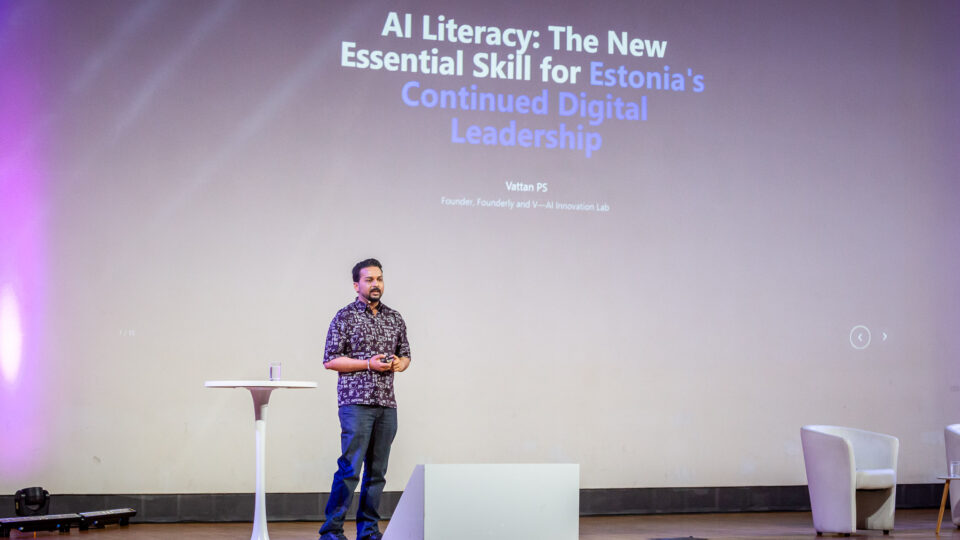
Varblane therefore believes it is worth focusing on areas in which Estonia can excel: “We could set ourselves the goal of becoming the world’s most AI-literate country.” In her view, a small country’s opportunities are most clearly reflected in its people’s knowledge and skills.
Põld sees one opportunity for Estonia in cybersecurity and the development of trustworthy AI. “We are very strong in cybersecurity,” she said, adding that Estonia could stand out for its ability to develop secure AI for use in working life.
Strong cooperation creates strong technology
The international dimension of AI extends beyond technology and economics. The question of which countries and companies we depend on, and which systems we are willing to trust, is becoming increasingly important.
The panellists agreed that complete technological independence is neither realistic nor necessarily essential for a country such as Estonia. In Krause’s view, there is no need to do everything alone. The Nordic countries, for example, are trusted partners with which Estonia is already cooperating to increase computing capacity.
Põld also stressed that technological sovereignty does not mean every solution must be produced in Estonia. What matters more is knowing which partners can be relied on in critical situations.
Some critical capabilities must nevertheless remain in Estonia. According to Krause, local computing capacity would allow more sensitive state systems to be kept on Estonian territory, ensuring they could continue to function even if connections with the outside world were cut. International cooperation and local operational resilience are therefore compatible.
“We could set ourselves the goal of becoming the world’s most AI-literate country.”
Doris Põld sees an opportunity for Estonia in cybersecurity and the development of trustworthy AI. Photo: Pexels
Trust as Estonia’s competitive advantage
European debates on AI often raise the question of whether strict rules protect people or hold back innovation. The panellists differed on this point. Vilo believes the problem is not necessarily the rules themselves, but how cautiously they are interpreted. “It is easier to say that something is prohibited than to find ways to enable innovation without putting people’s safety at risk,” he said.
According to Põld, businesses are usually burdened not by a single regulation, but by the accumulation of different requirements. For a small technology company, entering the European market may mean having to comply simultaneously with rules on AI, cybersecurity and its particular sector. “Should the next person you hire be an AI engineer developing the product, or a lawyer with a thorough understanding of European Union requirements?” Põld asked, describing a familiar dilemma for entrepreneurs.
Krause believes Europe’s common rules also have a strength: they help create an environment in which people can trust technology. Estonia’s digital state has been built on the same principle: new solutions must be understandable, transparent and safe for people to use.
“It is easier to say that something is prohibited than to find ways to enable innovation without putting people’s safety at risk.”
The most important investment: education
At the end of the discussion, the participants were asked what Estonia’s next big step could be after the ID card and X-Road, the data exchange layer that allows government information systems to exchange data securely. Varblane’s answer was brief: “The first thing that comes to mind is educating our people.”
In her view, Estonia’s small size brings advantages of its own: “That is our opportunity: to dare to experiment and lead the way.” AI could help make the public sector, healthcare and education more efficient, which is becoming particularly important as the working-age population shrinks.
Vilo stressed that AI development is built on long-term research. He said the current lead held by the United States and China had not emerged overnight, but was the result of decades of investment. “Technology comes from research. Education comes from research. Deep tech comes from research.” This is precisely why he considers strong education in mathematics and technology so important. “Every field now depends on it.”
A small country such as Estonia cannot win the AI race through computing power or investment. It can, however, invest in its people, knowledge, trust and capacity for cooperation. Building on these strengths could help Estonia find niches that enable it to become more than a user of technologies developed by others, and instead offer solutions needed elsewhere in the world.
“Technology comes from research. Education comes from research. Deep tech comes from research.”
The panel “The International Dimension of AI” took place at the autumn seminar of TalTech’s AI Focus Centre, held on 22–23 October at LaSpa in Laulasmaa. The AI autumn seminar brought together TalTech researchers, doctoral candidates and representatives of the public sector and partner organisations. Its aim was to discuss developments in artificial intelligence, present TalTech’s AI research and create new opportunities for collaboration.