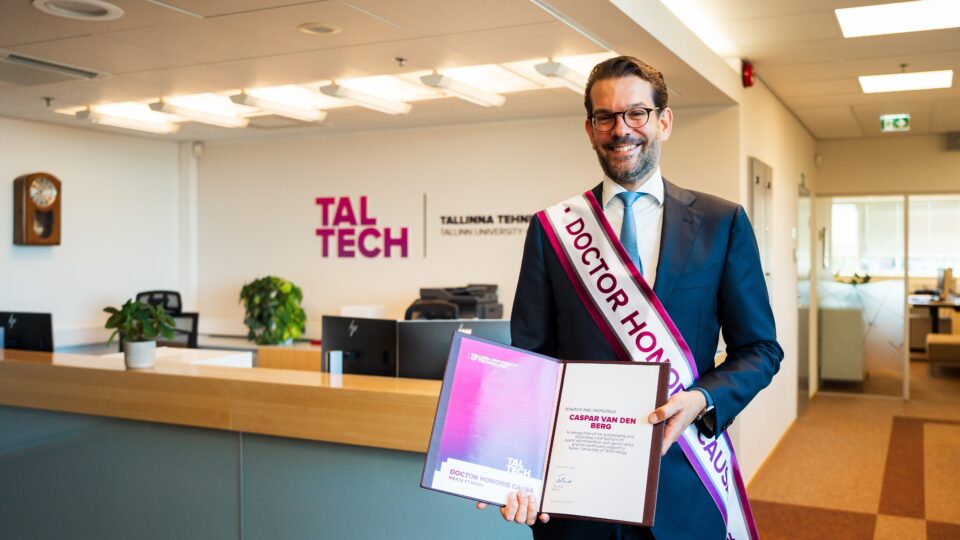
Mente et Manu peatoimetaja


A digital state can be fast and open, but that alone is not enough to maintain trust. Külli Taro says Estonia needs stronger foundations for its state and shared agreements on how to bring together democracy, citizen participation and the possibilities of technology.
Estonia has a newly elected president, the government is being reshuffled, and public debate revolves around surveillance, a shortage of money and security. Large paintings adorn the walls of Külli Taro’s office. She is accustomed to thinking critically about developments in society.
Taro is Head of Knowledge Transfer at the Ragnar Nurkse Department of Innovation and Governance and Programme Director for the master’s programme in Public Sector Management and Innovation. She also chairs the Council of Ethics of Officials, is Vice-Chair of the Estonian Cooperation Assembly and comments on social issues as an expert in Vikerraadio’s daily commentaries.
Külli has taken part in public debate since her student days, particularly on policymaking. She is drawn to the interdisciplinary nature of public administration: it brings together economics, law, psychology, sociology, political science and many other fields that make up our everyday lives.
You have been directly involved in public administration since your student days and still contribute to society on several levels. If you are interested in what happens in society, is staying passive simply impossible?
I entered full-time public service in September of the final year of my bachelor’s studies and have indeed been directly involved ever since. But I have never applied to join any council, nor have I spoken publicly very often on my own initiative. I have always been invited, and it has been very difficult to decline.
Contributing to society is part of being a citizen, but it has always been part of my work too. My closer engagement with the public began while I was working at the National Audit Office. Once you have spoken publicly, people increasingly start asking for your opinion.
At TalTech, I am Head of Knowledge Transfer: someone who connects what the university does with what happens in society. My task is to explain how knowledge developed at the university can help solve social problems, and which actions will not lead to solutions.
I prefer, however, to contribute directly to solving problems rather than through the media.
I have never really had a burning desire to be in the public spotlight. If anything, I feel there is already rather too much of me everywhere.
What is your greatest passion or interest in public administration?
Interdisciplinarity. In public administration or political science, you need to know something about law, economics, sociology, psychology, international relations, political science and much else. I have always been fascinated by the connections and points of contact between different disciplines.
“Contributing to society is part of being a citizen, but it has always been part of my work too.”

Külli Taro says contributing to society is part of being a citizen, as well as part of her everyday work. Photo: Karl-Kristjan Nigesen
You only came to TalTech for your doctoral studies. How did your life or research career bring you here?
I completed a research master’s degree in Tartu, and because doing so alongside work was quite difficult, I had no plans to continue studying immediately. But I kept up with publications in the field’s research journals anyway, and at some point I was invited to undertake doctoral studies. I already knew the people here from Tartu, including my future doctoral supervisor, Tiina Randma-Liiv.
A great deal has changed over the 25 years since you began your studies. What stages has Estonian politics been through?
Oh, how everything has changed! These have been very, very exciting times. Even during my bachelor’s studies, I was invited to join the Ministry of Justice’s administrative law reform working group and had the opportunity to help reform a major area of law.
I worked in parliament, in the Riigikogu’s Constitutional Committee, when Estonia joined the European Union. At the time, parliament played a much more active role in lawmaking than it does today. Being able to observe that entire process every day, at very close quarters, was extremely important to me.
Later, it seemed to us that the state was more or less complete and only fine-tuning remained. In fact, however, the major reforms left the foundations rather thin. I mean our understanding of the role of the state and public service, and ensuring that the state’s pillars are properly established.
The roots of many problems and scandals lie in basic processes that have not been fully developed or do not work well. We have placed great emphasis on acting quickly, but what my colleagues in the department have written also matters: innovation needs a stable, strong state.
“Innovation needs a stable, strong state.”

Külli Taro has contributed to debates on public administration and policymaking since her student days. Photo: Karl-Kristjan Nigesen
Can we predict cycles in governance, as we do in the economy, for example?
I would call them trends or fashions, but they work a little like a pendulum. If, for a time, we have emphasised decentralisation or delegation to the private sector, we eventually begin to see the shortcomings and tend to reverse everything, even to overregulate. Whatever the prevailing fashion, we tend to take it too far. The pendulum must then be brought back, although it does not stop in the middle: it tends to swing to the other extreme.
When it comes to different stages and openness, very fundamental changes have taken place, linked to developments in both society and technology. It is now possible to follow everything in real time, and people already expect round-the-clock access to everything. This is a completely different way of operating. What used to be normal internal work within an institution is now often described as backroom dealing.
For example, we hold many public parliamentary committee meetings. When a meeting is public and streamed live online, the atmosphere of the discussion changes, affecting what is said, how it is said and what remains unsaid. Public meetings have an important role, but there must also be a place where matters can be discussed in confidence. That is how trust is built.
Now, however, you constantly have to bear in mind that anything you say may be used against you. Any phrase taken out of context can have the opposite effect to the one intended.
Does Estonia lack trust, then?
The crisis of trust in governance is a global problem. I mean trust within the state and between institutions, as well as between the state and its citizens. This crisis has been deepening.
Another important aspect is that, under our Constitution, we have built our state as a classical representative democracy. This allows people to fulfil their civic duty at the ballot box, elect the Riigikogu or a local council, and take part in referendums. At other times, citizens may participate in decision-making, but are not obliged to do so.
Having a say is work in its own right, and in the past it was inconceivable that citizens would have the time to keep up with everything constantly. Now people have more time and opportunities and want a more direct say in decision-making.
How should we respond? I feel we have not yet resolved this dilemma particularly well.
“The crisis of trust in governance is a global problem. […] This crisis has been deepening.”

Külli Taro believes the authors of Estonia’s Constitution did an excellent job, but there is room to improve the practice of governance. Photo: Karl-Kristjan Nigesen
Has the digital and social media age actually done open government a disservice, making governance more closed?
It works both ways. I feel that in Estonia, open government is often somewhat misunderstood: it is viewed too narrowly, through communication. In reality, it is a fundamental approach to governance based on the understanding that everything we do in this state is public, unless it concerns a state secret or material clearly intended for internal use.
This understanding is not widespread enough. Instead, documents increasingly tend to be marked “for internal use” (AK), restricting access.
For example, when students prepare analyses and reports based on internships in the public sector, some government agencies want to restrict access to their internship reports by marking them “for internal use”, even though there is no legal basis for doing so.
Has the pendulum swung the other way: has openness become so extensive that people want to close things off again? Or why are these internal-use stamps applied too readily?
Because people fear misinterpretation and the additional burden of explaining things.
But there is another side too. When the attention economy produces striking headlines from small extracts, it can deliberately create a false impression. Yet what goes around comes around: if the media do not use openness and trust responsibly, public institutions will inevitably begin to protect themselves.
When I entered the public sector, most work took place behind closed doors, but in an atmosphere of considerable mutual trust. Opposition MPs and officials in ministries led by different parties communicated a great deal. It was possible to discuss and resolve problems, reach agreements and honour them.
From a citizen’s perspective, governance was therefore more closed, but trust-based cooperation worked within the public sector. Now everything is formally open, but in reality there is less trust. We also see leaders within the same area of government, or politicians and officials, arguing with one another in the media. This does not create an atmosphere of trust or embody the idea of open government.
The principle of open government says that, as a rule, nothing should be kept secret. That does not mean everything must be available to watch online in real time, around the clock.
What should the university take from this?
For TalTech, it is very important to distinguish what is technologically possible from what we want and consider acceptable in society.
Technologically, the state could know everything about every person: what they eat and drink, how much exercise they take, their habits, whom they communicate with, how much they work, whether they wait for the green light or have exceeded the speed limit. But the ability to collect such data does not, in itself, mean that collecting and using it is justified in a democratic state.
Are we ready to replace democracy with algocracy: governance based on algorithms? Algocracy may be more efficient, but is efficiency the most important value? In Estonia, we are only beginning to shape these social agreements.
The role of value choices in organising society is becoming increasingly important. For example, energy production cannot be developed without technological and engineering expertise, but the choice of energy sources does not depend solely on technical feasibility or economic viability.
Using wood, oil shale, gas, oil and other energy sources raises questions about environmental impact, energy security, people’s wellbeing and responsibility towards future generations. To assess these effects and resolve questions of values, we need the social sciences alongside engineering expertise.
“Now everything is formally open, but in reality there is less trust.”

Külli Taro is drawn to the interdisciplinary nature of public administration, which brings together law, economics, political science and many other disciplines. Photo: Karl-Kristjan Nigesen
We live in a “post-truth age”, when anyone can believe they are right and everyone else is wrong. How much of a threat does this pose to democratic governance?
One of the Estonian Cooperation Assembly’s tasks is to run the Citizens’ Initiative Portal. When Ukrainian drones began straying into our territory, a couple of citizens’ initiatives were submitted demanding the closure of Estonian airspace.
The false claim that Estonia had allowed Ukraine to use its airspace to attack Russia had spread so widely that it prompted petitions attracting large numbers of signatures. We therefore needed an official source confirming that Estonia had not opened its airspace to Ukraine, so that we could refer to it.
This led to a broader understanding that we need reliable official information that we can cite immediately when necessary.
Does the business model of the media and social media, which encourages competition for attention and ever more striking headlines to secure a click or a glance, help or harm here?
Major publications have editorial teams: identifiable people with clear responsibility. On social media, however, you never know who is actually behind an account.
I do not blame a business for seeking profit, but the question is what we, as customers, are paying for and what we are entitled to expect from whom.
We must expect, and indeed demand, balanced information from public broadcasting, whereas we have to take private media as they are.
It is said that democracy may not be good, but it is the least bad form of government. What are its biggest weaknesses, and what can be done about them?
Although our society and technology are constantly developing, democracies have been in the minority worldwide for years, both in terms of the number of countries and the proportion of people living in them. Most countries are autocracies. There are reasons for this.
First, democracy cannot exist without respect for fundamental rights and freedoms. Democracy does not simply mean majority rule over a minority. The majority makes decisions, but must also respect the rights and freedoms of the minority.
Second, democracy cannot exist without free elections. Checks and balances and the possibility of a change of power must also be guaranteed. These are quite strict criteria.
We would no longer call the political system of ancient Greece a democracy today.
Is a presidential election with a single candidate a success or a failure for democracy?
Even in theory, there can be no more than four presidential candidates in the Riigikogu, given that nominating a candidate requires the signatures of 21 MPs. Reaching the 68 votes needed to elect a president inevitably requires prior agreements in parliament.
After all, the president was chosen by parliament, our only directly elected nationwide representative body. Moreover, the president was elected in the first round, meaning agreement was reached on a candidate whom a large majority was prepared to support. Our Constitution requires a very broad agreement to elect the president. So I would call it a success.
Compared with decades ago, people are increasingly afraid of losing. I took part in a discussion programme as the parliamentary election campaign was gathering pace and observed the vocabulary of the other participants. Everyone talked about those who were not elected as losers.
Is that one aspect of our success-obsessed society?
Perhaps people do think that coming second means losing. Yet an officially nominated candidate already has the support of at least 21 MPs, who represent roughly a fifth of the population. If the candidate then fails to secure the 68 votes needed for the presidency, that does not necessarily mean defeat. Yet that is how it is perceived.
“Democracy does not simply mean majority rule over a minority. The majority makes decisions, but must also respect the rights and freedoms of the minority.”
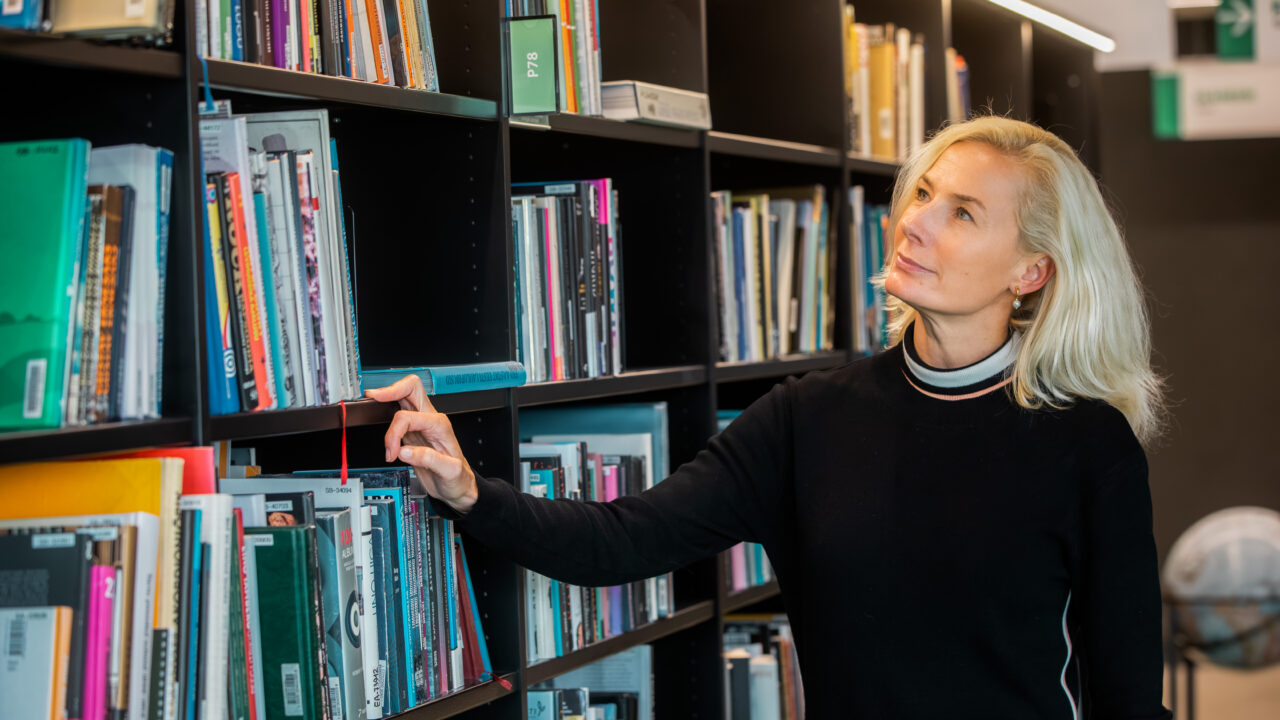
Külli Taro believes technology alone cannot solve every social problem: choices based on values are also needed. Photo: Karl-Kristjan Nigesen
Which form of government do you consider best, or least bad? Is it perhaps time for an entirely new system?
The people who drafted our Constitution did a fantastic job. We have a representative democracy that gives a very important role to different constitutional institutions and to checks and balances.
Even if, for some reason, you achieve a very large electoral victory, you cannot quickly change the country’s direction solely on the strength of a parliamentary majority. You still have to reach agreements and seek a balance.
You must always remember that someone else may come to power next time. When you set rules for the opposition, bear in mind that you may no longer be among the decision-makers in the next parliament.
So you cannot make rules for yourself or others, but always for the state. Does that mean we already have the best form of government?
In terms of our political system, we are in a very good position. There is no perfect form of government. Our current problems stem more from how we have put our system into practice. They are largely linked to broader trends that affect more than Estonia alone.
Speaking of new approaches, you lead the master’s programme in Public Sector Management and Innovation. Can you give some examples of public sector innovation?
Innovation includes process innovation, which is often forgotten. In the economy, innovation must create financial added value, but social benefits need not always be financial. What matters is making life better.
In the social sciences, we cannot create test-tube environments that allow us to try things out before deciding. The classical policymaking model involved conducting an analysis first and trying to assess every possible impact. A decision was then made and implemented, followed after a while by an evaluation of the results and changes if necessary.
Now there is an increasing shift towards experimental policymaking. We acknowledge from the outset that we do not know exactly how a decision will resonate in society or what its consequences will be. We therefore test activities within a limited period or a defined area before making a final decision.
The Finns have a lovely expression, humble government. The idea is to acknowledge that we do not know everything, but are willing to learn. We agree on objectives, but try different approaches in seeking solutions and are prepared to change earlier decisions in the light of new knowledge and results.
“In terms of our political system, we are in a very good position. There is no perfect form of government. Our current problems stem more from how we have put our system into practice.”

Külli Taro considers it important for people to take part in public debate and bring different perspectives to decision-making. Photo: Karl-Kristjan Nigesen
How do Estonians generally exercise their civic rights? Is voting enough, or should they do more?
People should certainly speak up when asked for their views or experiences. Substantive contributions and different perspectives are very important in lawmaking. If people do not use this opportunity, or only representatives of certain interests do, the picture remains incomplete.
I like the way our society is organised, relying heavily on freedom and responsibility. You are responsible for yourself, your family and your dependants, fulfil your obligations, whether military service or taxes, and otherwise live as you please. You can shape your own life.
How do you exercise your own civic rights?
I find it difficult to draw a line between wearing my citizen’s hat and contributing from a professional perspective. Throughout my public service career, I have worked in constitutional institutions that required political independence, which I have maintained.
I have always voted. As a citizen, I also contribute through volunteering.
Have you never been tempted to enter politics yourself?
I do not want to rule it out in principle, but for me it would mean giving up my entire professional career to date. There would be no way back, at least not to the positions I have held.
At present, I feel I can contribute to society and have a say without entering politics. I greatly respect people who work in politics. It is terribly hard work, but there are other ways to contribute to society.
Let us look at politicians’ side too: how well does our system of governance involve people and encourage participation?
I would distinguish advocacy from public demonstrations. A great deal of consultation is certainly done simply to tick a box. All representative organisations have highlighted this. For example, too little time is allowed for comments, or people receive no answers to their questions. A reasoned “no” is an answer too. There are certainly major shortcomings here.
Public demonstrations are mostly linked to demands for more money for a particular field. The COVID period was an exception, when people demonstrated for freedoms. Every field wants additional money. When different sectors’ needs constantly compete, it is important to make your voice heard. I think we actually have rather few demonstrations.
“A reasoned ‘no’ is an answer too.”

Külli Taro takes the Constitution of the Republic of Estonia from the shelf and recalls the purpose set out in its preamble: to guarantee the preservation of the Estonian nation, language and culture through the ages. Photo: Karl-Kristjan Nigesen
Estonia is a small miracle. How can we preserve our independence and this miracle amid global turbulence and the decline of democracy?
(She takes a velvet-bound copy of the Constitution of the Republic of Estonia from the shelf.) I think we must not forget the preamble to our Constitution: the purpose of our state is to guarantee the preservation of the Estonian nation, language and culture through the ages. That is something unique to us.
The Estonian Cooperation Assembly recently organised dialogue circles that discussed, among other things, what really worries people and what truly matters to them. We learnt that, alongside managing everyday life, people attach great importance to culture in all its forms. Our beautiful Estonian language and our own culture are very important to people!
If you could put one thing right in the world, what would it be?
The ability to enjoy life, even when things are difficult.
“The purpose of our state is to guarantee the preservation of the Estonian nation, language and culture through the ages.”