Editor of Trialoog

Estonia’s maritime sector will increasingly need people with IT, data, legal and other specialist skills alongside seafarers. Yet it is still widely seen as a traditional industry centred on ships and sailing. Participants at WISTA Estonia’s annual seminar concluded that universities, businesses, the state and local authorities must work more closely together to bridge this gap.
One of the biggest misconceptions is that maritime activity primarily means ships and navigating them, says Valentin Bratkov, Project Manager at TalTech’s Estonian Maritime Academy.
The actual labour market is much broader. Modern maritime activity encompasses automation, robotics, IT, environmental monitoring, energy, data, logistics and autonomous systems, among other fields. “You do not necessarily need a maritime background to enter the sector,” he noted.
Julia Rahula, Managing Director of Greencarrier Liner Agency Estonia, which handles international container shipping, also sees the sector’s outdated image as a labour market problem. Shipping is often still regarded as an old-fashioned industry, although it offers jobs in technology, sustainability, data analysis and engineering. “Young people do not realise how exciting this field can be or how interesting its jobs really are,” Rahula said.
Maritime careers require increasingly diverse skills
As maritime technology becomes more complex, expectations of employees change too. Bratkov noted that one fixed study programme will no longer suffice for the future maritime sector. Technology changes rapidly, so degree studies must be complemented by more micro-degree programmes and continuing education that allow people to keep updating their skills.
He also sees an important role for applied research. When researchers and businesses solve real problems together, the knowledge generated should reach teaching as quickly as possible, exposing students to the questions companies actually face while they are still at university.
Rahula says graduates generally enter the labour market with good technical knowledge. They more often lack readiness to work in a business environment.
In international logistics, this includes communicating with partners in different countries, handling unexpected developments and resolving complex situations. These skills are difficult to acquire solely in a classroom. “Companies want experienced people, but we know young people cannot already have that experience on their first working day,” Rahula observed.
Greencarrier has therefore created its own academy, where colleagues in other countries also support and mentor new employees. The company works with universities in Estonia and Sweden to provide feedback on the skills the labour market needs.
“Young people do not realise how exciting this field can be or how interesting its jobs really are.”
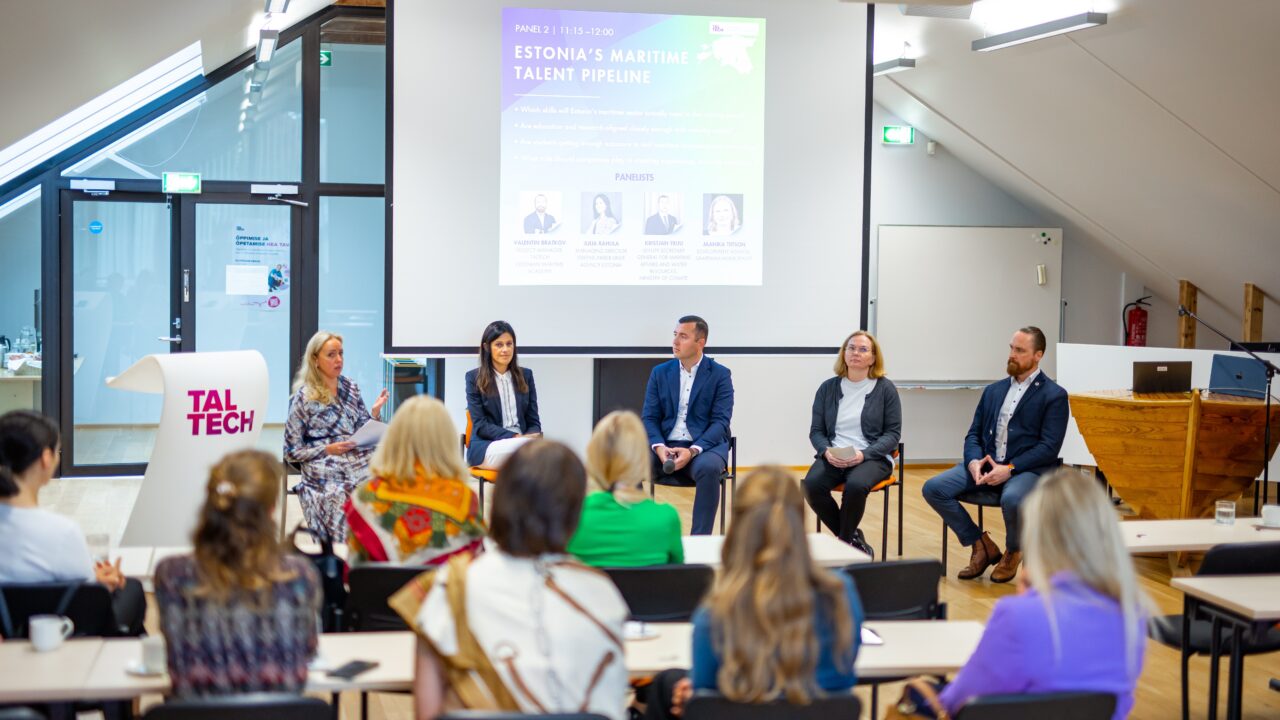
Valentin Bratkov, Julia Rahula, Kristjan Truu and Jaanika Tiitson discussed the next generation of maritime professionals, focusing on future skills, cooperation between education and business, and bringing young people closer to the sector. The panel was moderated by Riina Palu, manager of TalTech’s COL-TECH project. Photo: TalTech Smart Sea Centre of Excellence
Future skills emerge through cooperation
One of the panel’s sharpest questions concerned how well businesses’ actual needs reach universities.
Rahula gave a telling example: in more than twenty years in container shipping, a university had approached her only once to discuss the future skills companies expect from employees.
She believes responsibility cannot rest with universities alone. Businesses themselves should also be more active in telling educational institutions which knowledge and skills they need. “This concerns companies too: do we approach universities ourselves and provide feedback on what we expect?” she asked.
Kristjan Truu, Deputy Secretary General for Maritime Affairs and Water Environment at the Ministry of Climate, noted a growing need for specialists who understand another field as well as maritime affairs. The state increasingly considers maritime activity part of the blue economy, encompassing not only shipping and ports but also fisheries, aquaculture, tourism and energy.
Such specialists are not easy to find. Truu cited the ministry’s maritime department, which struggles to recruit a lawyer equally familiar with legislation and the maritime sector. “This is a major problem for us at the moment,” he said.
“Companies want experienced people, but we know young people cannot already have that experience on their first working day.”

Alongside specialist knowledge, employers expect young people to communicate, solve problems and cope in rapidly changing environments. Maritime education must therefore respond more closely to real labour market needs. Photo: TalTech Estonian Maritime Academy
The next generation is not nurtured in classrooms alone
The maritime sector’s future workforce depends on more than the skills universities and businesses give young people. Equally important is whether maritime regions can attract and retain young people and specialists. Jaanika Tiitson, Development Adviser at Saaremaa Municipality, brought this local perspective to the panel.
She said historical circumstances also affect Saaremaa’s maritime talent pipeline. During the Soviet period, people in many coastal areas lost their connection with the sea, weakening the transmission of skills and traditions between generations.
One of Saaremaa’s strengths, Tiitson said, is the availability of maritime education at different levels. Upper secondary pupils can learn small-craft handling, vocational students can study shipbuilding, and higher education and research opportunities continue at TalTech’s Kuressaare College. “Education is the most important thing,” she stressed.
Education alone is insufficient, however, if graduates have no reason to stay in the region or return. The same issue arises when a Saaremaa company finds a specialist elsewhere. A job alone may not be enough to prompt relocation, since the decision often involves the whole family. Saaremaa Municipality therefore helps newcomers find kindergarten places, extracurricular activities for children or employment for a spouse.
The panel’s message was that a single new study programme or recruitment campaign will not solve Estonia’s maritime workforce problem. Universities must connect teaching more quickly to businesses’ real problems, while businesses must contribute more to defining the skills they need. The state must update its understanding of maritime activity and take a broader view, while local authorities must create living environments that enable specialists to settle and work locally for the long term.
The first step, however, is to challenge the persistent belief that the maritime sector welcomes only those who want to go to sea.
“Education is the most important thing.”
TalTech’s Smart Sea Centre of Excellence and WISTA Estonia jointly held the annual seminar “Shaping the Next Generation in Maritime: Education, Technology, Research and Leadership” at TalTech Kuressaare College on 23 September 2026. It focused on attracting new people to the sector and the skills it will need in future.
Representatives of maritime affairs, education, research, the public sector and business discussed future skills, international cooperation, technology, leadership and women’s role in maritime activity. The keynote speaker was WISTA International President Elpi Petraki. The day concluded with a visit to the laboratories of TalTech’s Small Craft Competence Centre.