Direct current is moving from the laboratory to real-world applications

16.12.2025
Direct current is moving from the laboratory to real-world applications. 16.12.2025. If Estonia can bring together its pilot projects, a flexible regulatory environment, and top-level scientific expertise, it could become one of the first European countries where direct current shifts from being an exception to becoming the new norm. How does direct current fit into Estonia’s and Europe’s energy landscape? The opening session placed direct current within a broader energy policy context. Member of Parliament Mario Kadastik explained that the rapid phase-out of fossil fuels, the growth of renewable energy, and an increasingly strained electricity grid are forcing the search for more flexible solutions. In his view, direct current is a practical tool for keeping the system stable and using energy more intelligently at a time when peak demand and production coincide less and less often. Karin Lehtmets, Head of the Energy Markets Unit at the Ministry of Climate, outlined Estonia’s vision for the electricity system in 2035, stressing that the rapid spread of electric vehicles and heat pumps makes the traditional “one big grid” logic insufficient. According to her, direct current solutions could play a role if they help reduce transmission losses, enable the use of on-site generation in buildings during grid disturbances, and bring load management closer to the consumer. Hartwig Stammberger, Chairman of the Board of the Open Direct Current Alliance (an international cooperation network for DC technologies) and Head of Strategic DC Partnerships at Eaton (a global power management and electrical solutions company), explained that direct current has become one of the key technologies of Europe’s energy transition. It increases energy efficiency, reduces the load on the alternating current grid, and improves security of supply. The European SET Plan (Strategic Energy Technology Plan) focuses on practical pilot projects and the development of power electronics. According to Stammberger, the greatest value of DC networks lies in their ability to integrate local generation and storage into a single stable system that helps turn the energy transition into reality. From buildings to streets: the path of direct current into real infrastructure In the second session, the focus shifted from policy to the world of engineers and manufacturers – to how direct current actually reaches buildings, industry, and public space. Harry Stokman (DC expert, Current/OS Foundation) noted that their network already brings together more than a hundred international partners to harmonise the development of DC systems and ensure interoperability. His message was that direct current does not replace alternating current, but helps reduce load, increase reliability, and make energy prices more affordable. Hartwig Stammberger shared examples of factory microgrids in Germany and Austria, where direct current has helped reduce material use in long cable lines, smooth the start-up and shutdown of production equipment, and integrate energy storage and renewable sources without a complex AC system. Vicky Makridou introduced Schneider Electric’s DC Systems team, which develops DC-based building and industrial solutions in a context where electricity demand is growing faster than the AC grid can keep up. According to her, direct current is becoming central because most modern sources and loads – solar panels, batteries, LED lighting, and electronics – already operate on DC. Laurens Mackay, representing DC Opportunities, which focuses on the development and deployment of DC microgrid and distribution network technologies, presented an example of DC-powered street lighting, where cabling and equipment are designed specifically for direct current. He emphasised that lower energy losses over long lines, better fault detection, and the ability to connect other loads, such as chargers, to the same line give direct current a clear advantage. The practical side of DC deployment was highlighted by Kai Fieber, co-founder of energy company Ambibox, who explained why bidirectional DC charging is a logical intermediate step towards broader DC networks. Electric vehicles, batteries, and solar panels already operate on direct current – so why perform multiple unnecessary DC–AC–AC–DC conversions when devices can be connected directly to a DC system? Fieber stressed that this is technically possible already today; the main barriers are standards and business models. The role of the state, the grid, and companies Mikk Vahtrus, Head of Development at the Ministry of Economic Affairs and Communications, emphasised the role of the state in fostering innovation and cooperation between universities and companies. His focus was on applied research and partnerships that help move experiments into production. Reigo Haug, Head of the Substations Unit at Elering, spoke about the history of Estonia’s high-voltage direct current (HVDC) connections – the EstLink cables that link Estonia to neighbouring electricity markets and ensure security of supply. He stressed that while the public often perceives HVDC mainly as “large subsea cables”, these links also play a crucial role in frequency control and overall system stability. In the field of electric vehicles, Arsen Muradov, Vice President of Bercman Technologies, explained that fast DC charging is increasingly evolving into a business model where the charger is not just a device, but part of an integrated service. The rapid development of artificial intelligence brought data centres into focus. Max van de Poll, Head of Strategy at Skeleton Technologies, noted that the growing workload of AI servers causes short but very sharp power peaks that the electricity grid may struggle to handle. According to him, the solution lies in placing supercapacitors and storage systems directly next to the servers as a DC “buffer”, smoothing out these spikes before the load even reaches the grid. The future of direct current is being shaped at TalTech The workshop concluded with presentations of TalTech’s developments and pilot projects. Dmitri Vinnikov, leading Researcher and Academician at TalTech’s Department of Electrical Power Engineering and Mechatronics, introduced a project aimed at creating a factory-assembled, DC-powered A-energy-class residential building, where most loads and the entire energy system are based on direct current rather than alternating current. According to him, the project seeks to demonstrate three things: first, that a zero-emission building can be designed from the outset using DC logic; second, that the user experience is not affected by whether a socket delivers DC or AC; and third, that Estonia’s house-building industry has the potential to offer “DC-ready” buildings to the global market as a new export product. Andrei Blinov, senior Researcher at the Department of Electrical Power Engineering and Mechatronics, presented the Lightline project launched at TalTech, which aims to establish Estonia’s first public DC-powered street lighting system. LED luminaires that will be  installed in Lembitu Park in Tallinn and in the city of Jablonec nad Nisou in the Czech Republic will receive direct current directly, making it possible to eliminate AC power supplies and simplify the system. In the future, the same infrastructure could also be used to connect solar panels, battery storage, and electric vehicle chargers, with the goal of launching Estonia’s first public DC-based urban space solution in 2027. He added that street lighting infrastructure could evolve into a smart “opportunity charging” network – cabling that stands unused during the daytime could provide 10–20 kW of power for charging electric vehicles. Andrii Chub, senior Researcher at the Department of Electrical Power Engineering and Mechatronics, introduced TalTech’s Residential DC Innovation Hub – a modular container-based solution that functions as a fully operational DC test environment. It enables testing everything from DC-based solar energy systems and heat pumps to batteries, lighting, and USB-C-powered devices. The main objective is to test, demonstrate, and validate various DC solutions for use in future buildings. The technology is mature, but the ecosystem is still taking shape In the panel discussion that concluded the day, experts (Laurens Mackay, Hartwig Stammberger, Harry Stokman and president of Current/OS Foundation and representative of Schneider Electric Yannick Neyret) agreed that the main barrier to the wider adoption of direct current is not the technology itself, but the immaturity of the ecosystem. There are too few pilot projects – a handful of factories, street lighting installations, or examples from the Netherlands are not yet enough to build broad trust. It is also difficult to articulate a clear value proposition: taken individually, the benefits (efficiency, lower material use, longer lifespan, reliability) may seem modest, but together they make a system-level difference. Progress is further hindered by the classic “chicken-and-egg” problem: without products, networks are not built, and without networks, products are not developed. There is also a lack of clear political direction, risk-sharing mechanisms for early adopters, and investment support. A shortage of skills and education was also highlighted. Engineering education needs to integrate both alternating and direct current logic, but training is also required for designers, installers, consultants, and sales specialists. According to the experts, by 2035 direct current will see its widest adoption in data centres, electric vehicle charging, business parks, and communities where solar panels, batteries, chargers, and heat pumps are connected to the same network. In the longer term, a hybrid world will inevitably emerge: direct and alternating current will operate side by side, each finding its place where its strengths are most effective. The TalTech direct current innovation workshop demonstrated that technology is no longer the bottleneck – DC solutions for street lighting, charging, data centres, and residential buildings already exist and work. Further progress will depend on courage: the willingness of policymakers to adopt new solutions, the readiness of municipalities and grid operators to test them, the competence of specialists, and the ability of companies to recognise direct current as a competitive advantage.
Dmitri Vinnikov, Leading Researcher and Academician at TalTech’s Department of Electrical Power Engineering and Mechatronics, presented a project aimed at creating a factory-assembled, DC-powered A-energy-class residential building, where most loads and the entire energy system are based on direct current rather than alternating current. Photo: TalTech

Dmitri Vinnikov, Leading Researcher and Academician at TalTech’s Department of Electrical Power Engineering and Mechatronics, presented a project aimed at creating a factory-assembled, DC-powered A-energy-class residential building, where most loads and the entire energy system are based on direct current rather than alternating current. Photo: TalTech

TalTech’s direct current innovation workshop brought together the public sector, researchers, and entrepreneurs, all emphasizing one key point: the development of direct current (DC) is no longer confined to drawings and models, but is rapidly making its way into real buildings, streets, chargers, and data centres. The technology is already there – what is needed now is decisiveness.

If Estonia can bring together its pilot projects, a flexible regulatory environment, and top-level scientific expertise, it could become one of the first European countries where direct current shifts from being an exception to becoming the new norm.

How does direct current fit into Estonia’s and Europe’s energy landscape?

The opening session placed direct current within a broader energy policy context. Member of Parliament Mario Kadastik explained that the rapid phase-out of fossil fuels, the growth of renewable energy, and an increasingly strained electricity grid are forcing the search for more flexible solutions. In his view, direct current is a practical tool for keeping the system stable and using energy more intelligently at a time when peak demand and production coincide less and less often.

Karin Lehtmets, Head of the Energy Markets Unit at the Ministry of Climate, outlined Estonia’s vision for the electricity system in 2035, stressing that the rapid spread of electric vehicles and heat pumps makes the traditional “one big grid” logic insufficient. According to her, direct current solutions could play a role if they help reduce transmission losses, enable the use of on-site generation in buildings during grid disturbances, and bring load management closer to the consumer.

Hartwig Stammberger, Chairman of the Board of the Open Direct Current Alliance (an international cooperation network for DC technologies) and Head of Strategic DC Partnerships at Eaton (a global power management and electrical solutions company), explained that direct current has become one of the key technologies of Europe’s energy transition. It increases energy efficiency, reduces the load on the alternating current grid, and improves security of supply. The European SET Plan (Strategic Energy Technology Plan) focuses on practical pilot projects and the development of power electronics. According to Stammberger, the greatest value of DC networks lies in their ability to integrate local generation and storage into a single stable system that helps turn the energy transition into reality.

From buildings to streets: the path of direct current into real infrastructure

In the second session, the focus shifted from policy to the world of engineers and manufacturers – to how direct current actually reaches buildings, industry, and public space.

Harry Stokman (DC expert, Current/OS Foundation) noted that their network already brings together more than a hundred international partners to harmonise the development of DC systems and ensure interoperability. His message was that direct current does not replace alternating current, but helps reduce load, increase reliability, and make energy prices more affordable.

Hartwig Stammberger shared examples of factory microgrids in Germany and Austria, where direct current has helped reduce material use in long cable lines, smooth the start-up and shutdown of production equipment, and integrate energy storage and renewable sources without a complex AC system.

Vicky Makridou introduced Schneider Electric’s DC Systems team, which develops DC-based building and industrial solutions in a context where electricity demand is growing faster than the AC grid can keep up. According to her, direct current is becoming central because most modern sources and loads – solar panels, batteries, LED lighting, and electronics – already operate on DC.

Laurens Mackay, representing DC Opportunities, which focuses on the development and deployment of DC microgrid and distribution network technologies, presented an example of DC-powered street lighting, where cabling and equipment are designed specifically for direct current. He emphasised that lower energy losses over long lines, better fault detection, and the ability to connect other loads, such as chargers, to the same line give direct current a clear advantage.

The practical side of DC deployment was highlighted by Kai Fieber, co-founder of energy company Ambibox, who explained why bidirectional DC charging is a logical intermediate step towards broader DC networks. Electric vehicles, batteries, and solar panels already operate on direct current – so why perform multiple unnecessary DC–AC–AC–DC conversions when devices can be connected directly to a DC system? Fieber stressed that this is technically possible already today; the main barriers are standards and business models.

Kai Fieber, co-founder of energy company Ambibox, highlighted the practical side of deploying direct current, explaining why bidirectional DC charging is a logical intermediate step on the path toward broader DC networks. Photo: TalTech

Kai Fieber, co-founder of energy company Ambibox, highlighted the practical side of deploying direct current, explaining why bidirectional DC charging is a logical intermediate step on the path toward broader DC networks. Photo: TalTech

The role of the state, the grid, and companies

Mikk Vahtrus, Head of Development at the Ministry of Economic Affairs and Communications, emphasised the role of the state in fostering innovation and cooperation between universities and companies. His focus was on applied research and partnerships that help move experiments into production.

Reigo Haug, Head of the Substations Unit at Elering, spoke about the history of Estonia’s high-voltage direct current (HVDC) connections – the EstLink cables that link Estonia to neighbouring electricity markets and ensure security of supply. He stressed that while the public often perceives HVDC mainly as “large subsea cables”, these links also play a crucial role in frequency control and overall system stability.

In the field of electric vehicles, Arsen Muradov, Vice President of Bercman Technologies, explained that fast DC charging is increasingly evolving into a business model where the charger is not just a device, but part of an integrated service.

The rapid development of artificial intelligence brought data centres into focus. Max van de Poll, Head of Strategy at Skeleton Technologies, noted that the growing workload of AI servers causes short but very sharp power peaks that the electricity grid may struggle to handle. According to him, the solution lies in placing supercapacitors and storage systems directly next to the servers as a DC “buffer”, smoothing out these spikes before the load even reaches the grid.

The future of direct current is being shaped at TalTech

The workshop concluded with presentations of TalTech’s developments and pilot projects.

Dmitri Vinnikov, leading Researcher and Academician at TalTech’s Department of Electrical Power Engineering and Mechatronics, introduced a project aimed at creating a factory-assembled, DC-powered A-energy-class residential building, where most loads and the entire energy system are based on direct current rather than alternating current. According to him, the project seeks to demonstrate three things: first, that a zero-emission building can be designed from the outset using DC logic; second, that the user experience is not affected by whether a socket delivers DC or AC; and third, that Estonia’s house-building industry has the potential to offer “DC-ready” buildings to the global market as a new export product.

Andrei Blinov, senior Researcher at the Department of Electrical Power Engineering and Mechatronics, presented the Lightline project launched at TalTech, which aims to establish Estonia’s first public DC-powered street lighting system. LED luminaires that will be  installed in Lembitu Park in Tallinn and in the city of Jablonec nad Nisou in the Czech Republic will receive direct current directly, making it possible to eliminate AC power supplies and simplify the system. In the future, the same infrastructure could also be used to connect solar panels, battery storage, and electric vehicle chargers, with the goal of launching Estonia’s first public DC-based urban space solution in 2027.

He added that street lighting infrastructure could evolve into a smart “opportunity charging” network – cabling that stands unused during the daytime could provide 10–20 kW of power for charging electric vehicles.

Andrii Chub, senior Researcher at the Department of Electrical Power Engineering and Mechatronics, introduced TalTech’s Residential DC Innovation Hub – a modular container-based solution that functions as a fully operational DC test environment. It enables testing everything from DC-based solar energy systems and heat pumps to batteries, lighting, and USB-C-powered devices. The main objective is to test, demonstrate, and validate various DC solutions for use in future buildings.

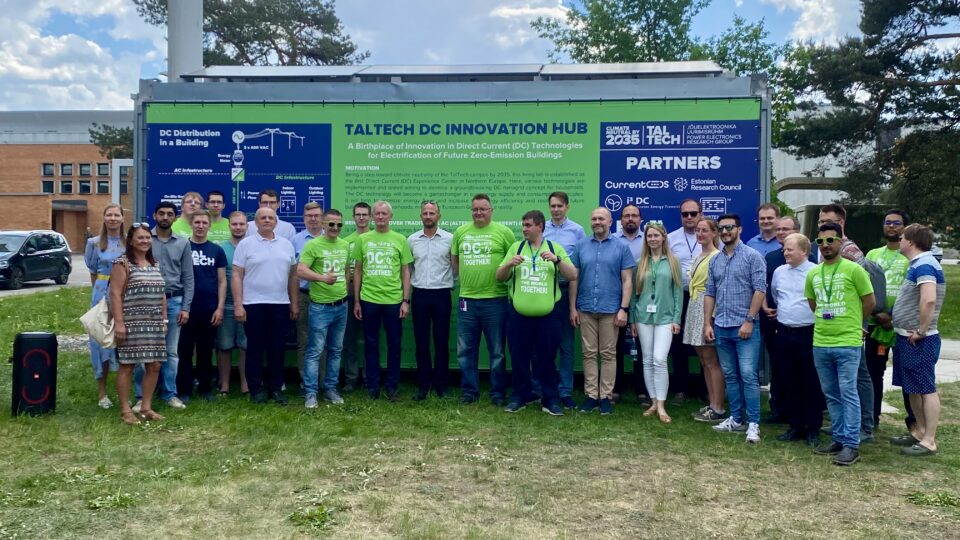
TalTech’s direct current innovation workshop brought together the public sector, researchers, and entrepreneurs, all emphasising one key point: the development of direct current is no longer confined to drawings and models, but is rapidly finding its way into real buildings, streets, chargers, and data centres. The technology is already there – what is needed now is decisiveness. Photo: TalTech

TalTech’s direct current innovation workshop brought together the public sector, researchers, and entrepreneurs, all emphasising one key point: the development of direct current is no longer confined to drawings and models, but is rapidly finding its way into real buildings, streets, chargers, and data centres. The technology is already there – what is needed now is decisiveness. Photo: TalTech

The technology is mature, but the ecosystem is still taking shape

In the panel discussion that concluded the day, experts (Laurens Mackay, Hartwig Stammberger, Harry Stokman and president of Current/OS Foundation and representative of Schneider Electric Yannick Neyret) agreed that the main barrier to the wider adoption of direct current is not the technology itself, but the immaturity of the ecosystem. There are too few pilot projects – a handful of factories, street lighting installations, or examples from the Netherlands are not yet enough to build broad trust. It is also difficult to articulate a clear value proposition: taken individually, the benefits (efficiency, lower material use, longer lifespan, reliability) may seem modest, but together they make a system-level difference.

Progress is further hindered by the classic “chicken-and-egg” problem: without products, networks are not built, and without networks, products are not developed. There is also a lack of clear political direction, risk-sharing mechanisms for early adopters, and investment support.

A shortage of skills and education was also highlighted. Engineering education needs to integrate both alternating and direct current logic, but training is also required for designers, installers, consultants, and sales specialists.

According to the experts, by 2035 direct current will see its widest adoption in data centres, electric vehicle charging, business parks, and communities where solar panels, batteries, chargers, and heat pumps are connected to the same network. In the longer term, a hybrid world will inevitably emerge: direct and alternating current will operate side by side, each finding its place where its strengths are most effective.

The TalTech direct current innovation workshop demonstrated that technology is no longer the bottleneck – DC solutions for street lighting, charging, data centres, and residential buildings already exist and work. Further progress will depend on courage: the willingness of policymakers to adopt new solutions, the readiness of municipalities and grid operators to test them, the competence of specialists, and the ability of companies to recognise direct current as a competitive advantage.