
Trialoog editor

Many scientific ideas stall not because of technology, but because there are no people to bring them to market. Tallinn University of Technology is now seeking to consciously bridge the gap between science and business by looking for external co-founders for more than ten research projects.
Although Tallinn University of Technology has for years positioned itself as a driver of Estonia’s economic development, such active recruitment of co-founders marks a new phase. The university is currently seeking business-minded partners for more than ten research teams, with additional ideas expected to follow later. “For us, proactively searching for co-founders is a first,” said Caroline Rute, Head of Entrepreneurship at TalTech.
Science does not sell itself
The university has a simple yet ambitious goal – to turn more research results into economically viable outcomes. Ideas should not remain confined to scientific papers but reach the market as products and services.
According to Rute, some research outcomes make it possible to immediately find a partner from Estonia’s business landscape and begin applying the idea through existing companies. At the same time, many ideas require the creation of entirely new teams in order to move forward.
“A structure consisting only of university employees would quickly lead to a situation with limited opportunities,” Rute explained. Bringing in people from outside the university makes it possible to launch entrepreneurial ventures more frequently, while allowing researchers to continue focusing on their core academic work.
At the same time, not all university research results are automatically suitable for commercialisation. TalTech evaluates ideas using an international methodology that assesses technological maturity, market potential and the realism of further development.
Two parallel pathways are always considered – licensing the technology to an existing company or building a new spin-off around it.
In practice, however, it is often difficult to find a partner willing to adopt an idea in its early form. “Creating a new company means that the risk and responsibility move to those who are prepared to carry them,” Rute noted.
The ideas currently seeking co-founders span a wide range of fields, from wood chemistry and energy to IT and materials technology. This diversity reflects the broad spectrum of spin-offs that have previously emerged from TalTech.
The goal: the next Estonian success story
Rute explained that successfully launching a start-up – or any company, really – requires a unique combination of personal qualities, motivation, skills and networks. “Leading a new company is very different from taking a salaried job. For some people it suits them perfectly, while for others not at all,” she said.
Previous industry experience can certainly help accelerate a company’s growth, although it is also possible to quickly learn the specifics of a field while working in it.
According to Rute, the greatest challenge in bringing science-based technologies to market is the long period between the product and the end customer, which involves resource-intensive and high-risk development work. “Very often it is all worth the effort, but that does not make the effort any smaller,” she said.
At the same time, international trends show growing interest in deep technology – investors in both Europe and the United States are increasingly looking for science-based solutions.
TalTech’s ambition goes beyond creating a handful of companies. The goal is systemic change – helping to launch several new high-growth-potential spin-offs every year.
“The ideal scenario would be companies with strong growth potential and ambitious teams. We are eagerly waiting for Estonia’s next major deep-tech success story – something comparable to the scale of Skype or Wise,” said Rute.
“The ideal scenario would be companies with strong growth potential and ambitious teams. We are eagerly waiting for Estonia’s next major deep-tech success story – something comparable to the scale of Skype or Wise.”
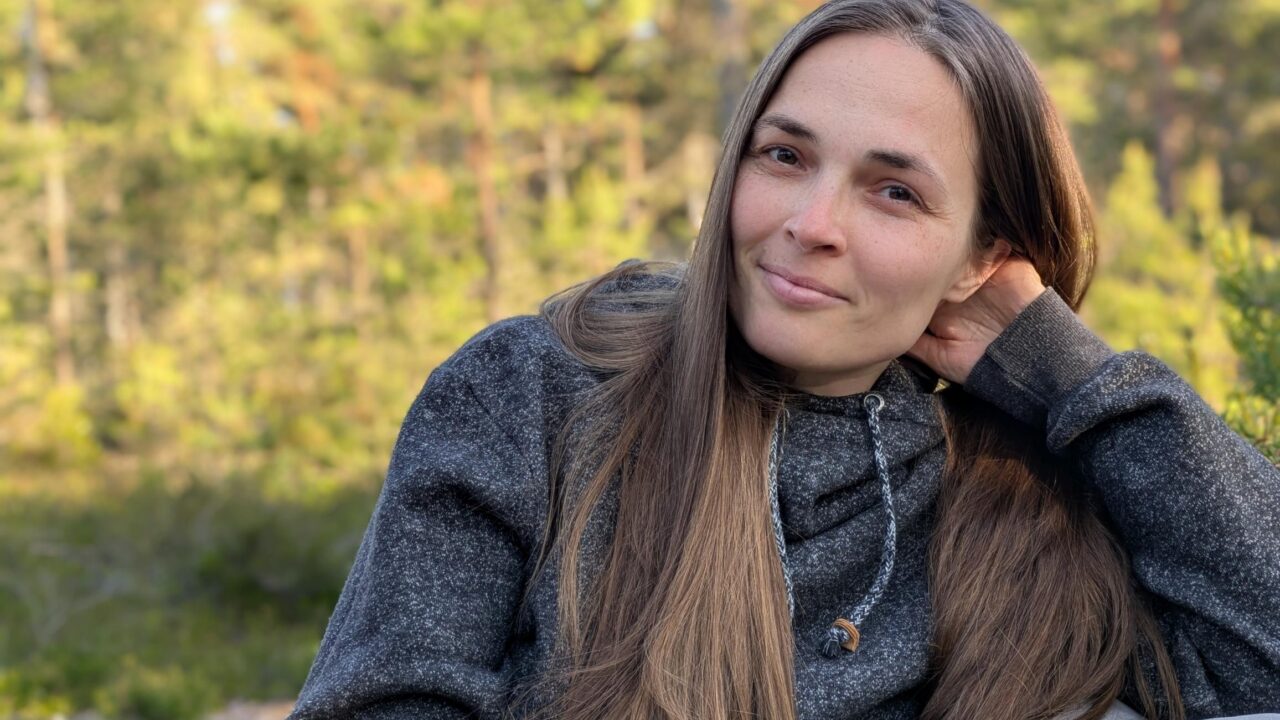
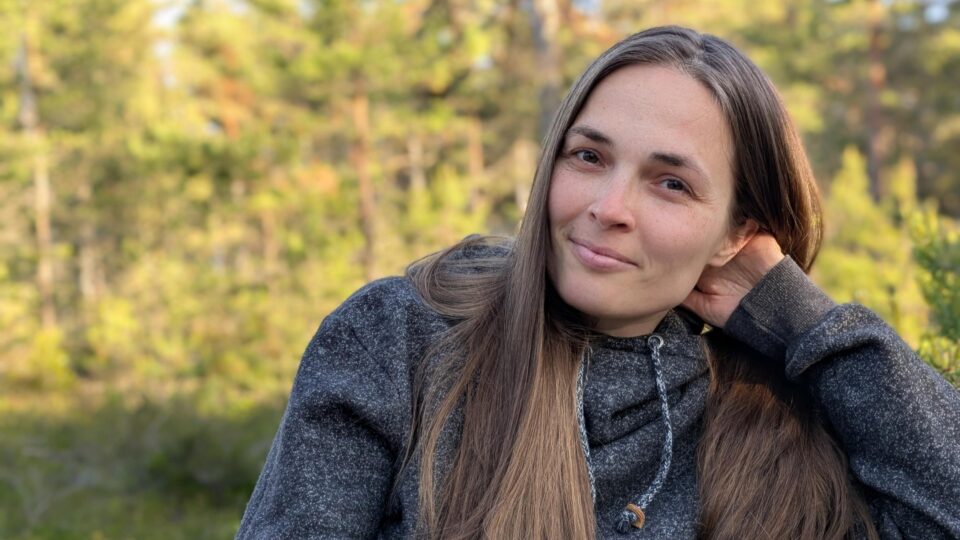
Caroline Rute explained that successfully launching a startup – and in fact any kind of business – requires a magical combination of personal qualities, motivation, skills, and connections. Photo: Private collection.
How to measure the impact of urban space
The first example is StressSense – a solution that makes it possible to objectively measure how different environments affect people.
At the core of the idea is the analysis of physiological signals, including brain activity, heart function and body temperature, to assess a person’s stress level. This helps identify which urban spaces or building solutions calm people down and which ones create tension.
“When we measure a person’s stress level, we are not relying on what they think they feel, but on what their body actually shows,” explained Kristjan Pilt, a senior researcher at TalTech and one of the scientists involved in the project.
The solution emerged from the FinEst Centre for Smart Cities project, which studied how urban space affects people’s well-being. “We found that urban environments that look quite similar from the outside can produce completely different stress levels – in one place a person feels good, in another they do not,” Pilt described.
Mapping human well-being creates an entirely new opportunity: to assess urban planning or real estate development not only through aesthetics or functionality, but also through people’s actual experience.
Although the StressSense technology has been scientifically developed and protected by a patent, no clear business model has yet been found for it. Pilt himself does not wish to engage in entrepreneurship, preferring to remain focused on research and advisory work. This is why the project is now looking for a co-founder or entrepreneur who could turn the technology into a viable product and service.
According to Pilt, the product could primarily be used by real estate developers and cities that want to make better spatial design decisions and avoid costly solutions that cause stress.
A sensor solution that helps avoid unnecessary trips
The second example is TarkBox – an Internet of Things-based monitoring system that makes it possible to track the fill level of waste containers in real time and empty them based on actual need rather than a fixed schedule. The idea grew out of a practical problem: containers either overflow or are emptied too early.
“Our system aims to create the conditions for emptying waste containers according to fill levels rather than schedules,” said Heiko Põdersalu, head of VIDRIK (Virumaa innovation centre of digitalisation and green technologies). A monitoring-based approach could help reduce unnecessary trips, cut costs and ease the environmental burden.
By now, TarkBox has been developed into a functioning integrated solution: it includes a sensor-based monitoring platform, a casing and software that tracks the condition of containers on a computer screen and collects data for further analysis.
The system does not have to be limited to waste containers. The same logic could also be used for sawdust silos, wastewater tanks or other systems that depend on fill levels and environmental conditions. “Our main challenge is no longer so much the technology, but the need and the customer whose problem our idea solves best,” Põdersalu admitted.
TarkBox is currently looking for someone who could help map the market more clearly, identify suitable fields of application and turn the solution into a viable company.
According to Põdersalu, the project needs someone who can carry out a strong market analysis, spot real business opportunities and help decide whether the monitoring system’s greatest potential lies in waste management or in another field. In other words, the team is not merely looking for a manager, but for a co-founder who can help build a clear and scalable business around the technical prototype.
“Our main challenge is no longer so much the technology, but the need and the customer whose problem our idea solves best.”
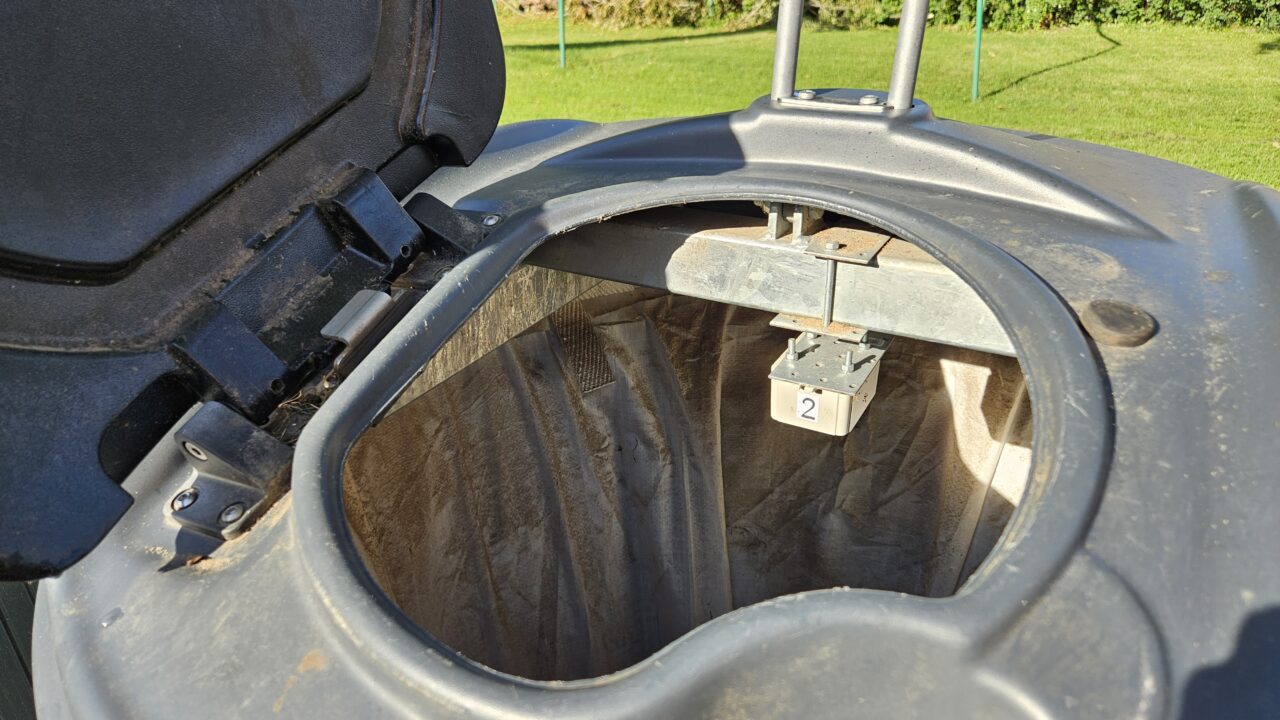
Today, TarkBox has been developed into a fully functional integrated solution: it includes a sensor platform with embedded sensors, a housing unit, and software that monitors container conditions via a computer interface and collects data for further analysis. The photo shows a TarkBox sensor installed inside a container. Photo: Heiko Põdersalu
Turning snow into summer cooling
One of the technological ideas for which TalTech is seeking a co-founder is SnowShine – a solution that aims to turn a typical “problem” of cold climates into an opportunity. The core idea is to collect and store snow in winter and use it for cooling buildings in summer. While conventional cooling systems generate cold using electricity, here the “cold” already exists in nature – the challenge is how to store and use it intelligently. “It’s similar to storing solar energy in summer for heating applications; however, instead of the sun, we use snow in winter – the cold is already available, we just store it in an insulated pit,” explains the project’s author, Sreenath Sukumaran, a researcher at TalTech’s Department of Energy Technology.
Although snow storage technology has been tested in countries like Sweden and Norway, its wider adoption has been hindered by the lack of awareness and practical decision-making tools. This is exactly the gap SnowShine aims to fill by offering a software-based framework to assess the feasibility and cost-effectiveness of such systems. The project already has a working prototype and strong technical expertise, but the next step requires market logic and business development. “The biggest challenge is not the technology itself, but the fact that people find it hard to believe it can actually work,” Sukumaran notes.
This is why SnowShine is looking for a co-founder with a strong business background, preferably in the energy sector. “The ideal candidate would take the project to the next level – shaping a viable business model, securing first customers, and leading the launch of pilot projects.” An understanding of the academic environment is also important, as this is not just a startup idea but a science-based development where research and business must go hand in hand.
“The ideal candidate would take the project to the next level – shaping a viable business model, securing first customers, and leading the launch of pilot projects.”
Explore TalTech’s technology portfolio to discover ideas that are looking for a co-founder.
The initiative is part of the Deep Tech Startup Network, through which the state is investing more than 12 million euros into the development of science-based companies, with the aim of bringing researchers and entrepreneurs together and helping innovation reach the market faster. The network is funded by the Ministry of Economic Affairs and Communications.