
Cracking the code of the sugars that protect newborns

10.12.2025
Cracking the code of the sugars that protect newborns. 10.12.2025. Speaking at the TalTech School of Science conference, Tõnis Kanger, a tenured full professor in the Department of Chemistry and Biotechnology, emphasised that these compounds are found only in breast milk – and the pressure on chemists to synthesize them has never been greater. Understanding their structure and developing synthetic schemes could lead to improved infant formula, new therapeutic approaches and a clearer picture of how immunity develops in early life. This is why scientists around the world are striving to synthesize these complex molecules in the laboratory. But copying what nature performs so effortlessly is anything but simple. HMOs consist of precisely arranged monosaccharide units, and even the slightest structural alteration can change how they function. The hidden complexity of sugar chemistry HMOs are built from monosaccharides that behave in exquisitely delicate ways. The smallest structural tweak can transform a familiar molecule into something entirely different. Because of this finely tuned behaviour, chemists must guide each reaction with exceptional precision to obtain the correct structures. Every time two sugars are linked, two choices prove decisive: which hydroxyl group of several participates in the reaction, and whether the resulting bond adopts the alpha or beta orientation. These decisions determine whether the molecule resembles the HMO found naturally in breast milk. If the configuration is wrong, the biological effect may vanish. Nature produces more than 200 HMOs, yet industry can reliably manufacture only a handful. “Currently, only one to two of them are available. They are in commercial baby food. In total, six of them have been approved for infant formula,” Kanger noted. Without better synthetic methods, babies who rely on formula miss out on the diversity of protective molecules that breastfeeding provides. “Currently, only one to two of them are available. They are in commercial baby food. In total, six of them have been approved for infant formula.”   TalTech’s selective tools – and what they make possible To confront these challenges, Kanger’s group has developed selective methods that make sugar chemistry more manageable. One breakthrough involved using an immobilised industrial enzyme, Novozyme 435, which proved unexpectedly precise and selective in removing protective groups from sugars. This controlled behaviour enables researchers to build HMOs step by step without sacrificing accuracy. Another important advance came from identifying a catalyst that directs the reaction towards forming the correct type of bond. Kanger’s group demonstrated that a simple pyridinium-based catalyst can reliably push the reaction towards the beta form – the version nature prefers. These developments matter far beyond the laboratory. As chemists learn to synthesize the structures found in human milk, they unlock new possibilities for enhancing infant nutrition, preventing infections and deepening our understanding of how early microbial interactions shape long-term health. Why this field deserves greater attention Although sugars play a central role in biology, carbohydrate research has never enjoyed the limelight afforded to nucleic acids or proteins. Those fields have accumulated well over a dozen Nobel Prizes each; carbohydrates have earned only three – all more than half a century ago. As Kanger remarked: “No chemical synthesis of carbohydrates has been awarded so far.” Yet HMOs reveal just how profoundly we underestimate these molecules. “Cracking their structure is not merely a technical puzzle – it is a gateway to understanding how human life organises itself from its very beginnings.” As scientists learn to synthesize HMOs with precision, the implications could be transformative: infant formulas that more closely mimic breast milk, new strategies to prevent early-life infections and a richer grasp of the chemical signals that guide development. If any field deserves a future Nobel Prize, it is surely this one. “Cracking their structure is not merely a technical puzzle – it is a gateway to understanding how human life organises itself from its very beginnings.”
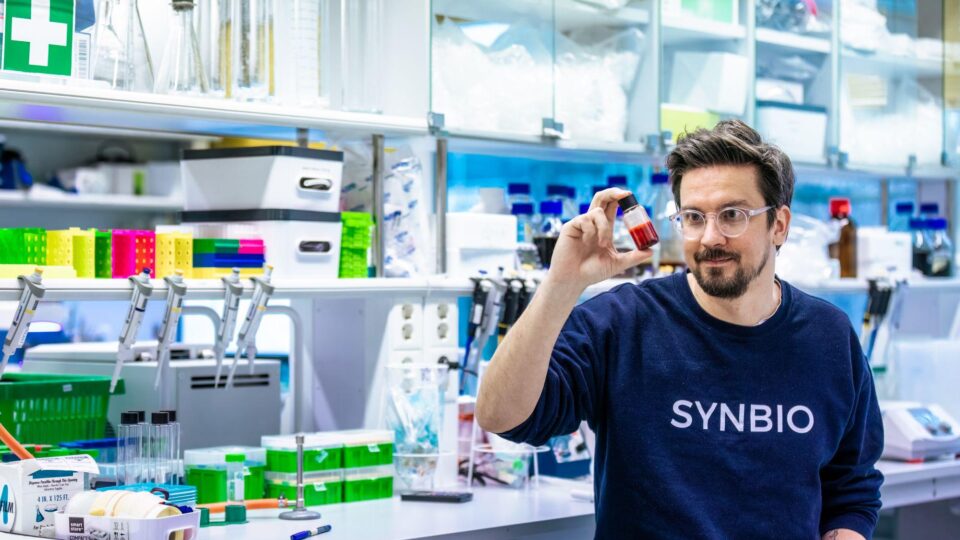
Tõnis Kanger explained that without improved synthesis methods, children who grow up on infant formula will miss out on many of the protective molecules that breast milk naturally provides. Photo: Unsplash

Tõnis Kanger explained that without improved synthesis methods, children who grow up on infant formula will miss out on many of the protective molecules that breast milk naturally provides. Photo: Unsplash

Synthesising the complex sugars found in human breast milk is not just a chemical challenge – it is a key to a healthier future for infants.

Speaking at the TalTech School of Science conference, Tõnis Kanger, a tenured full professor in the Department of Chemistry and Biotechnology, emphasised that these compounds are found only in breast milk – and the pressure on chemists to synthesize them has never been greater.

Understanding their structure and developing synthetic schemes could lead to improved infant formula, new therapeutic approaches and a clearer picture of how immunity develops in early life. This is why scientists around the world are striving to synthesize these complex molecules in the laboratory.

But copying what nature performs so effortlessly is anything but simple. HMOs consist of precisely arranged monosaccharide units, and even the slightest structural alteration can change how they function.

The hidden complexity of sugar chemistry

HMOs are built from monosaccharides that behave in exquisitely delicate ways. The smallest structural tweak can transform a familiar molecule into something entirely different. Because of this finely tuned behaviour, chemists must guide each reaction with exceptional precision to obtain the correct structures.

Every time two sugars are linked, two choices prove decisive: which hydroxyl group of several participates in the reaction, and whether the resulting bond adopts the alpha or beta orientation. These decisions determine whether the molecule resembles the HMO found naturally in breast milk. If the configuration is wrong, the biological effect may vanish.

Nature produces more than 200 HMOs, yet industry can reliably manufacture only a handful.

“Currently, only one to two of them are available. They are in commercial baby food. In total, six of them have been approved for infant formula,” Kanger noted.

Without better synthetic methods, babies who rely on formula miss out on the diversity of protective molecules that breastfeeding provides.

“Currently, only one to two of them are available. They are in commercial baby food. In total, six of them have been approved for infant formula.”
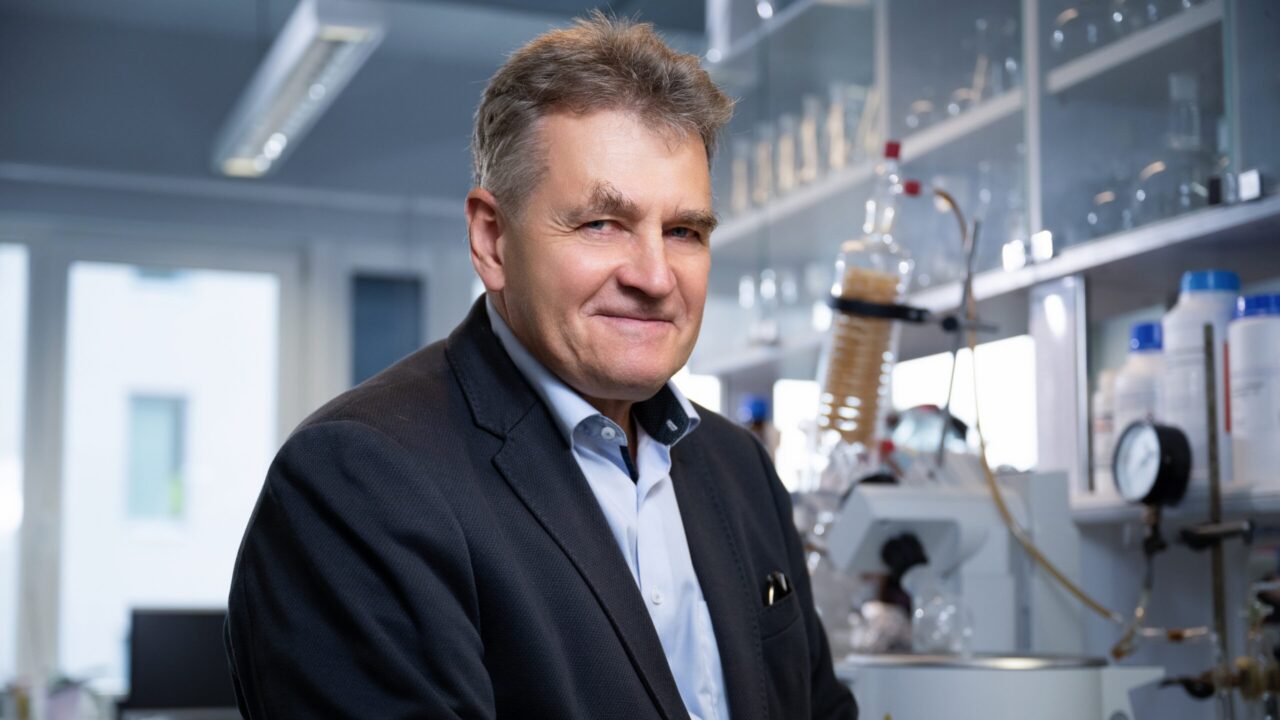
 

Tõnis Kanger. Photo: Aivo Kallas

Tõnis Kanger. Photo: Aivo Kallas

TalTech’s selective tools – and what they make possible

To confront these challenges, Kanger’s group has developed selective methods that make sugar chemistry more manageable. One breakthrough involved using an immobilised industrial enzyme, Novozyme 435, which proved unexpectedly precise and selective in removing protective groups from sugars. This controlled behaviour enables researchers to build HMOs step by step without sacrificing accuracy.

Another important advance came from identifying a catalyst that directs the reaction towards forming the correct type of bond. Kanger’s group demonstrated that a simple pyridinium-based catalyst can reliably push the reaction towards the beta form – the version nature prefers.

These developments matter far beyond the laboratory. As chemists learn to synthesize the structures found in human milk, they unlock new possibilities for enhancing infant nutrition, preventing infections and deepening our understanding of how early microbial interactions shape long-term health.

Why this field deserves greater attention

Although sugars play a central role in biology, carbohydrate research has never enjoyed the limelight afforded to nucleic acids or proteins. Those fields have accumulated well over a dozen Nobel Prizes each; carbohydrates have earned only three – all more than half a century ago. As Kanger remarked: “No chemical synthesis of carbohydrates has been awarded so far.”

Yet HMOs reveal just how profoundly we underestimate these molecules. “Cracking their structure is not merely a technical puzzle – it is a gateway to understanding how human life organises itself from its very beginnings.”


As scientists learn to synthesize HMOs with precision, the implications could be transformative: infant formulas that more closely mimic breast milk, new strategies to prevent early-life infections and a richer grasp of the chemical signals that guide development. If any field deserves a future Nobel Prize, it is surely this one.

“Cracking their structure is not merely a technical puzzle – it is a gateway to understanding how human life organises itself from its very beginnings.”