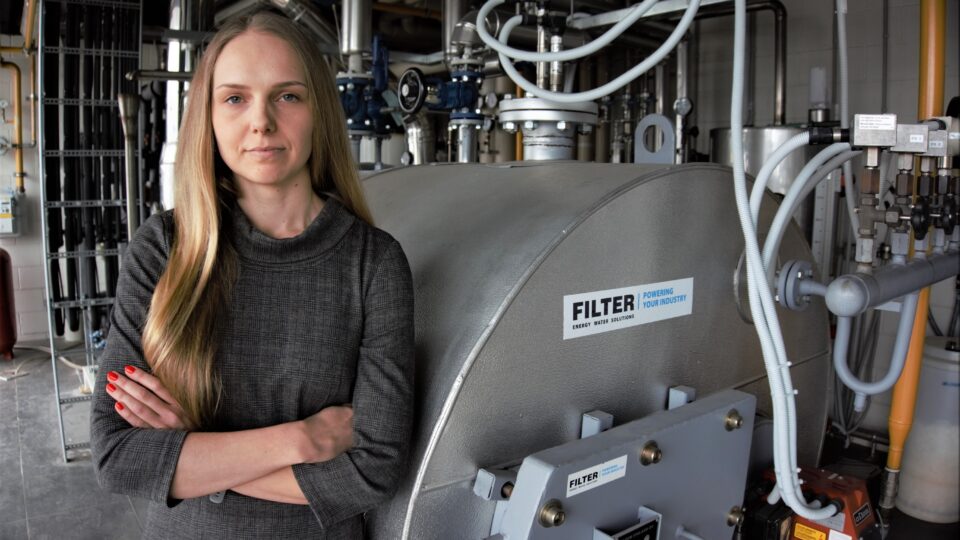
President of the Estonian Association of Engineers, Engineer of the Year 2025, CEO and co-founder of technology company Nave Tech
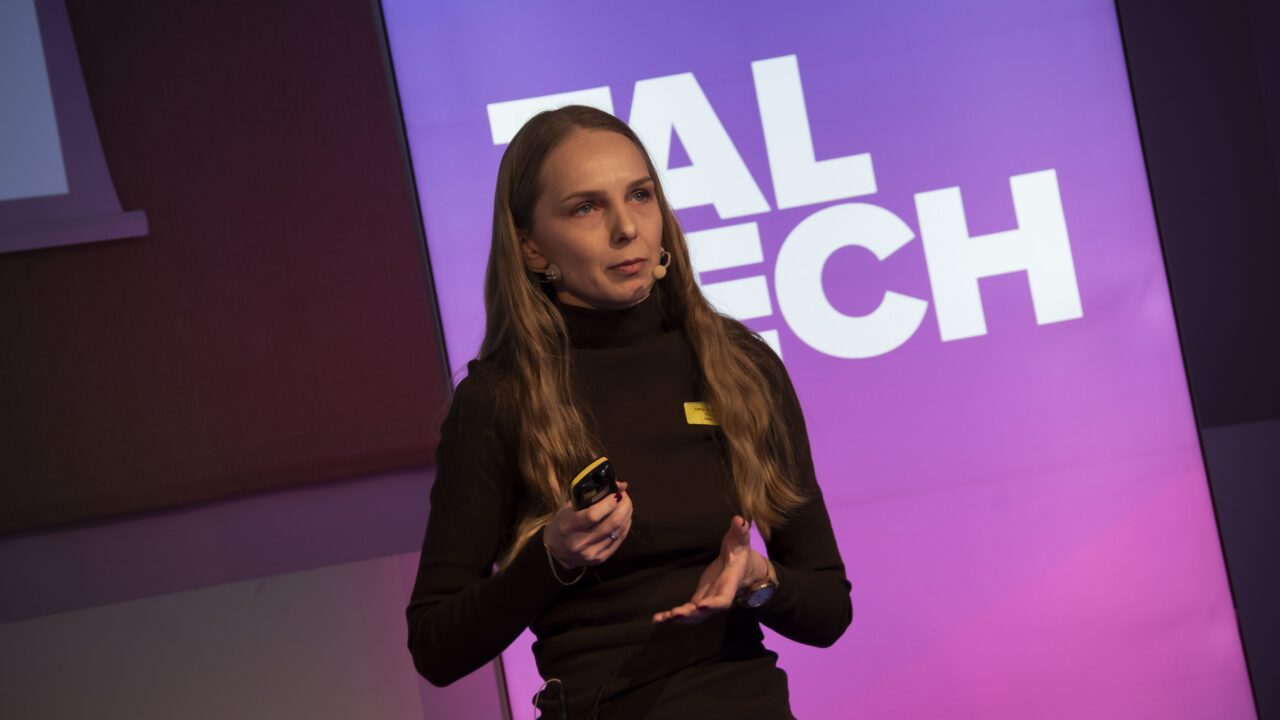
Mathematics is more than formulas and calculations. It trains us to solve problems, try different approaches and persevere when we meet an obstacle. We need these skills every day — at school, at work and in life, writes Cathy-Liis Põlluveer, President of the Estonian Association of Engineers.
Imagine walking home from work. Your usual route is blocked by something you did not expect: a pipe has burst underneath the road and the whole street has been dug up. You cannot get through. What do you do? Lie down, close your eyes and wait for the unexpected obstacle to disappear?
Probably not. Or perhaps you do lie down, but only to start calculating the cosine rule with pencil and paper to find the most direct alternative route home?
Probably not that either. Most likely, you intuitively look for another route. If you do not know one, you open Google Maps or call a friend. If your phone battery is flat, you ask a passer-by. However hopeless things become, you probably do not give up, because you have learned that every problem has a solution. If one approach fails, you try another. Congratulations! You have just solved a real-life problem. The very same skill is trained in mathematics lessons.
For me, mathematics is primarily training — a problem-solving gym. Small logic tasks let you practise solving mathematical problems so that you are sufficiently trained to handle situations in real life too.
This skill is not needed only by engineers, researchers and senior executives. Everyone solves problems every day, regardless of age, education or occupation. We usually do not notice, because this thinking is simply part of life.
We solve problems when choosing a home internet package or planning a route from A to B, taking account of time, money, energy levels, weather and much more. Sometimes we are troubled by things we cannot change: a government decision, a neighbour’s uncut lawn or an irritating colleague. For someone, even this article may be a problem — if it is hard to understand or they disagree with its ideas.
But let us return to the dug-up road. Suppose you have tried every alternative route and still cannot find a solution. You are losing hope; hunger, cold and darkness are closing in. Eventually, you force your way through — jumping a fence and crossing the construction site despite signs warning of danger and prohibiting access. You may well clash with the construction workers too. But you will not give up, because you have to get home and have exhausted every option you know.
“For me, mathematics is primarily training — a problem-solving gym.”
Dividing mathematics into broad and narrow courses has not proved its worth; instead, it creates divisions and increases inequality. Illustrative image
When the options in between go untried
Taking this argument a little further and looking at the wider world, perhaps humanity’s growing distance from mathematics has brought us to a point where our overall problem-solving fitness is declining. Increasingly, we reach the last resort — force or conflict — quite quickly, because the options in between remain unexplored.
If the road is blocked, I charge through the trench, ignoring the danger. If I dislike this article, I post an angry, hateful comment. Because I simply do not know what else to do. Problem-solving and logical thinking are skills like any others: without practice, they weaken. TalTech Rector Tiit Land has said: “Mathematics is the art of thinking. And people who think usually find common ground easily.”
Sometimes accepting a situation is also a solution: there are as many different opinions as there are people. The same applies in mathematics. More than 350 proofs are known for Pythagoras’ theorem, one of mathematics’ best-known relationships. All reach the same result through entirely different lines of reasoning. If even the most rigorous science permits so many routes to the same truth, perhaps we should allow ourselves and others that freedom too.
Drifting away from mathematics starts at school
At fifteen, Estonia’s young people are among the world’s best in mathematical training: according to the PISA 2025 results published this autumn, our pupils ranked first in Europe in mathematics. Then something happens. The further young people progress through school, the more they steer away from mathematics and the sciences. Almost one in four basic school graduates fails the mathematics examination, and half of upper secondary pupils choose the narrow mathematics course, whose average examination result this year was 35.4 out of 100.
Choosing narrow mathematics is not merely taking an easier route: it closes doors. Admission to programmes in engineering, IT, natural sciences and many business and economics fields requires the broad mathematics examination. Broad mathematics also gives applicants to medicine and law a clear advantage.
Yet a fifteen- or sixteen-year-old may have no idea what they want to do with their life. Legally, they cannot buy alcohol, rent a flat without parental consent or establish a company. But we often let them make a decision that closes off whole professional fields without any support.
In thermal engineering, nature never breaks the second law of thermodynamics: heat flows spontaneously only from a warmer body to a colder one. Reversing that requires energy. Our brains behave similarly when making choices: without an additional incentive to take the harder route, we choose the easier one.
If we offer young people an easier path, they are therefore highly likely to take it. We should not divide upper secondary mathematics into narrow and broad courses. We need a common mathematics curriculum for everyone until the end of upper secondary school: one focused on understanding, responsive to each pupil and clear about its real-life relevance. The pull-out teaching approach used by the Iga Laps on Andekas foundation shows that individual needs can be accommodated: within one class, a faster learner can receive an appropriate challenge and another pupil the support they need.
A mathematics panel at Haridustreff suggested that there will always be pupils who fail, and that we should focus instead on high achievers scoring above ninety. I agree to some extent, because those high achievers will probably drive Estonia’s future innovation. Yet I am convinced that everyone else — the critical mass of young people outside that group — matters at least as much. How much can innovators achieve if society as a whole lacks the most basic ability to solve its own problems?
“Problem-solving and logical thinking are skills like any others: without practice, they weaken.”

Concern about mathematical skills, and therefore future students, prompted a special initiative: the nationwide online maths challenge held on 2 October. Photo: TalTech
Why learn what machines can already do?
What if this “training” has become too detached from real life? What happens to a young person’s motivation when a teacher explains exponential functions, but they still do not know whether to find x or y — or why x keeps disappearing in the first place?
I completely understand a young person’s confusion when they wonder: why must I learn delightful polynomials such as quadratic or cubic functions when the AI on my phone solves them in twenty seconds? In about half an hour, I could vibe-code a program to solve both quadratic and trigonometric equations, formatted exactly as I like — even with rainbow-coloured graphs. Why does my teacher torment me with drawing sine curves and hyperbolas when machines have done that faster and more accurately since before my parents were born?
Neuroscientist Jaan Aru has said: “School is brain training. It is the only very well-proven brain training that actually raises IQ and intelligence. It is not the specific content being learned, but the process itself that makes us smarter.” The same desire to sharpen our minds explains why people voluntarily solve sudoku in their free time. They are simply arbitrary boxes and numbers in endless variations. Yet they contain those tiny eureka moments that nourish logical thinking.
The film The Karate Kid is a good example of how seemingly unrelated, dry training prepares us for something bigger. Before practising a single strike, the master asks his student to spend a day painting a fence. The student is puzzled, but later realises it trained his balance and endurance for combat. To me, all those complicated mathematical theorems and formulas are exactly like painting that fence: preparation.
“To me, all those complicated mathematical theorems and formulas are exactly like painting that fence in The Karate Kid: preparation.”
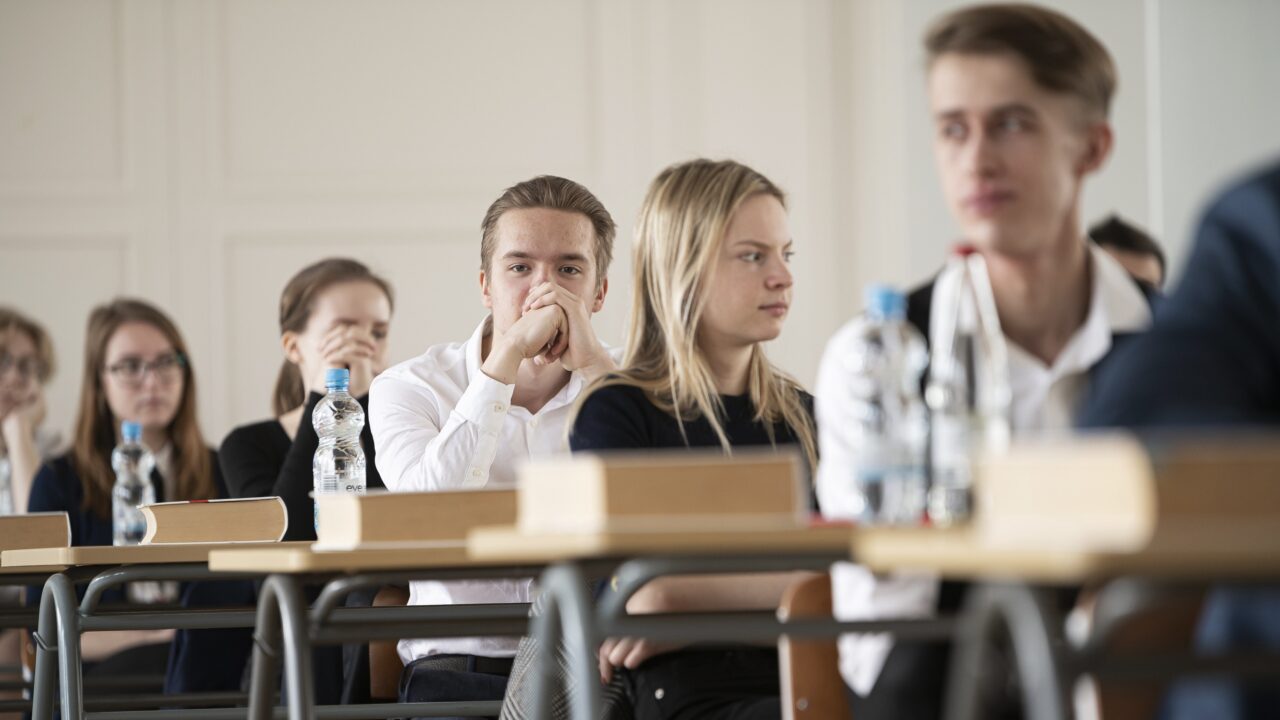
Students taking a state examination: mathematics tests both knowledge and problem-solving skills. Photo: Aivo Kallas
Teachers must explain what it is all for
The digital age and AI have taken real life so far ahead of curricula that the gap between “painting with a brush” and “learning karate” is greater than ever. Instead of painting the fence, we now memorise the paint’s chemical composition. Nobody tells pupils that they will soon actually paint the fence. Or that karate comes afterwards. Or why any of it matters.
Someone must answer that question. Until curricula catch up, the teacher standing in front of the class has to do so. Every day, teachers must explain the logic of the paintbrush afresh in a rapidly changing world.
If AI solves a quadratic equation in twenty seconds, a mathematics lesson must offer something a phone cannot: the ability to formulate the problem, question the answer and recognise when a machine is wrong. That is a major responsibility, and it requires support: time to prepare meaningful lessons and recognition that preserves the profession’s dignity. Teachers themselves want this too.
Liisa Liesment’s 2026 master’s thesis at Tallinn University found that the changes teachers most wanted concerned workload (21.8%) and recognition of the profession (14.8%), rather than pay. The least we can do as parents is respect teachers’ time: you have one child; a teacher has 150.
Mathematics is not just for engineers
You might think I am writing this as President of the Estonian Association of Engineers solely because I worry about future engineers: choosing narrow mathematics further shrinks an already depleted engineering community. My concern is broader. I worry about society as a whole: what will become of us if we do not train our ability to solve problems?
Mathematics is a cornerstone of being human. It is like music: few of us can read a score, but we cannot imagine life without music. Rarely does anyone say music is not for them. People say that about mathematics every day. Yet it is untrue: you have already solved numerous problems today without recalling a single formula.
The nationwide online maths challenge returns on 8 October. Give it a try — for the training, not the grade. And next time you feel like charging through a trench or posting an angry comment, solve a sudoku instead.
“Mathematics is a cornerstone of being human.”