
Trialoog's editor

Narfe World, a company founded by TalTech alumnus Abdul Salam Mohammed and his team, aims to transform how people plan their travels. The platform, currently being developed in the Tehnopol AI Accelerator, uses artificial intelligence to turn travel content produced by online creators into personalised itineraries.
According to Mohammed, 52,000 people visited Narfe’s website in the month before the interview, which he regards as a clear indication of demand for the service. The company has set itself an ambitious target: within five years, Narfe aims to become one of the world’s leading AI-powered travel-planning platforms.
The idea for Narfe arose from a simple observation: people increasingly find travel inspiration on Instagram, TikTok and other digital platforms. Turning the places featured in those videos into a practical itinerary, however, often requires extensive research and a considerable amount of time.
From a travel video to a practical itinerary
Narfe offers users two ways to create a travel plan. The first is to upload up to three travel videos that appeal to them. The AI analyses the places shown or mentioned in the videos, matches them to real-world locations and uses the information to create an itinerary.
Alternatively, users can start from scratch by describing the kind of trip they want. Narfe then searches videos by travel content creators for material matching their preferences, identifies suitable places and uses them to produce a personalised itinerary.
Mohammed said the idea grew partly out of his own travel experiences. After visiting Spain, he later discovered places in other people’s travel videos that had been only 15 or 20 minutes from his route, yet he had not known they were there. Narfe is designed to help travellers discover such places before they leave and bring them together in an itinerary tailored to their interests.
Mohammed said Narfe had placed particular emphasis on trustworthiness.
“When AI gives you a travel itinerary, you do not always know where the information has come from or whether you would trust it enough to base your trip on its recommendations. We want to create itineraries that people feel confident using in real life.”
For this reason, Narfe draws on posts by travel content creators and the experiences of people who have visited the places being recommended. The company has also established a partner programme. When a user creates an itinerary based on videos by a participating content creator, the creator receives 20 per cent of the net revenue generated by the service.
“We want to create itineraries that people feel confident using in real life.”
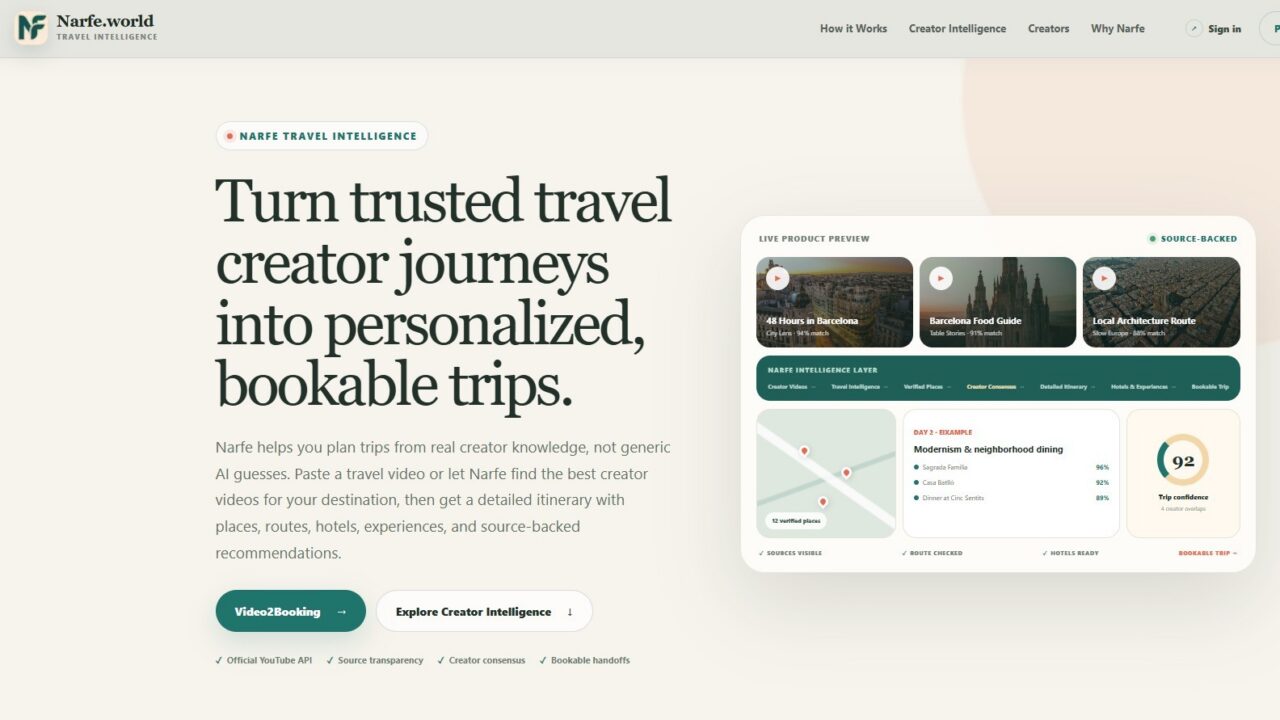
According to Mohammed, 52,000 people visited Narfe’s website in the month before the interview, which he believes confirms that there is market demand for such a service. Image: Narfe.World
Using AI is no longer enough
Mohammed said one of the greatest challenges in developing an AI-based service was producing results that were both useful and reliable.
“Anyone can use AI today. The much harder part is turning it into a functioning product that creates genuine value for the user and can be trusted.”
Narfe must identify locations shown in travel videos, match them to real-world places and recognise when several videos feature the same location. If a video was filmed in Tallinn’s Old Town, for example, the system must identify the exact place and ensure it is not added to the same itinerary more than once.
According to Narfe’s internal testing, the platform matches places shown in videos to their correct real-world locations in more than 99 per cent of cases.
Mohammed’s experience reflects a broader shift in the AI sector: simply using artificial intelligence may no longer be enough to provide a competitive advantage. The quality, accuracy and reliability of the underlying data are becoming increasingly important.
“Anyone can use AI today. The much harder part is turning it into a functioning product that creates genuine value for the user and can be trusted.”

Alongside Abdul Salam Mohammed (right), the Narfe team includes Afroz Ahmed Khan and Jack Flowers. Photo: private collection
AI is changing how people plan their travels
Mohammed believes artificial intelligence is already changing how people search for travel information. In the past, travellers would visit several websites and compare different recommendations. Increasingly, they now ask ChatGPT, Claude or another large language model directly.
“People already have their preferred AI tools. They ask AI directly which restaurant to choose or what they should not miss in Barcelona,” Mohammed said.
He believes travel is particularly well suited to AI because every itinerary depends on the traveller’s individual preferences, including their budget, available time, interests and travelling companions. Mohammed also expects AI to play an increasingly important role in other consumer-facing sectors, particularly retail, where it can help people navigate large numbers of options and receive more personalised recommendations.
Narfe’s business model was also shaped by research into user behaviour. The company initially considered introducing a monthly subscription, but its market research found that most people would use a travel-planning service only once to three times a year. Narfe therefore chose a transaction-based model: the first itinerary is free, while each subsequent itinerary costs €5.

A road trip through the American Southwest. Narfe uses AI to identify places featured in travel videos and turn them into personalised itineraries. Photo: Dino Reichmuth / Unsplash
From studying at TalTech to building a company
Mohammed graduated from the TalTech School of Business and Governance in 2022 with a master’s degree in Technology Governance and Digital Transformation. Although the programme focused largely on the public sector and digital transformation, it encouraged him to think more broadly about how technology affects people’s lives and the kinds of problems it can help solve.
The rapid development of artificial intelligence gave him an opportunity to turn those ideas into something tangible. Narfe has also received support from the Tehnopol AI Accelerator, which has helped the team develop an initial concept and early working version into a company.
Working with mentors, the team has addressed issues ranging from product development, marketing and strategy to founders’ agreements and intellectual property.
According to Mohammed, the accelerator encouraged the team to confront a fundamental question: does Narfe solve a problem that people genuinely need to have solved? To find out, the team conducted market research and spoke to potential users. Their feedback helped shape not only the original idea but also the platform and its business model.
This led Mohammed to conclude that “there is no such thing as a good or bad idea. Every idea can be good. But the journey from an idea to a company can be a long one, even if the distance between the two may seem small at first.”
Before developing a product, Mohammed believes it is essential to establish whether the problem it is intended to solve is significant enough to make a meaningful difference to people’s lives. He recommends speaking directly to potential users and asking whether and how the product would help them, as well as how much they would be prepared to pay for it.
AI may make it possible to turn an idea into a prototype faster than ever, but every entrepreneur must still answer one question: does anyone actually need my product?
“There is no such thing as a good or bad idea. Every idea can be good. But the journey from an idea to a company can be a long one, even if the distance between the two may seem small at first.”