

Expert at TalTech’s Entrepreneurship Department

DCR Technologies, a company spun out of TalTech, is developing technology that helps prepare today’s electrical devices for the arrival of direct-current networks. The company aims to reduce energy losses and prevent costly retrofits in the future.
After more than a century of alternating-current dominance, the energy system is moving once again towards direct current. Solar panels, batteries, electric vehicles and much of today’s electronics already run on direct current, even though power grids and most devices are still built around the logic of alternating current. DCR Technologies, a startup spun out of TalTech, is developing technology that helps bridge the gap between the two types of current and prepares electrical devices for the direct-current networks of the future.
Much of today’s technology is based on direct current, or DC. Solar panels produce direct current, and it is also used by batteries, electric vehicles and many electronic devices. Electricity, however, still reaches homes and businesses mainly as alternating current, or AC. This means devices must constantly convert electricity from one form to another, causing energy losses and additional costs.
DCR Technologies is developing a power electronics platform that will allow today’s AC devices to operate in DC networks without the need to replace their hardware. In other words, the company’s solution helps extend the lifetime of existing devices in a situation where energy systems are increasingly being pushed towards direct current.
“Today, the system involves many unnecessary conversions, and our technology helps reduce them,” explained Kristjan Lind, co-founder of DCR Technologies.
The company’s solutions are intended, for example, for electric vehicle chargers, solar energy equipment, energy routers and DC microgrids. According to Oleksandr Husev, CEO and co-founder of DCR Technologies and a senior researcher at TalTech, these solutions will become especially important once DC networks are adopted more widely – without such developments, Husev argues, it will no longer be possible, for example, to charge electric vehicles.
According to DCR Technologies, its technology increases the total cost of electrical and charging systems by around 2–3%, but at the same time helps avoid expensive retrofits later on.
From a research project to a company
The idea behind DCR Technologies emerged from TalTech research projects in 2019. Even then, Husev was already thinking about the technologies the energy sector would need in the longer term.
“I was thinking not only about tomorrow’s solutions, but about the solutions needed the day after tomorrow,” Husev recalled. “Even in the project application at the time, I wrote that the aim could be to commercialise this technology.”
The path from laboratory to company has not, however, been straightforward. First, the team developed a contactless charging system for electric scooters. Market testing showed, however, that companies were not yet ready to adopt such a solution. The team then moved on to DC-DC converters, where it saw greater market potential.
According to Husev, building a deep-tech company requires a researcher to keep learning constantly and to be ready to cope with uncertainty. In his view, researchers who are considering creating a spin-off should focus on solving practical problems and learn how to explain their ideas to a wider audience.
The formation of the team has played an important role in the company’s development. In addition to researchers, Kristjan Lind joined the company as a co-founder with a business background; his experience in scaling hardware companies helped assess the technology’s market potential. Today, the company’s core team consists mainly of people with a research background, including Husev’s former doctoral students. The next step is to start growing the engineering team.
“Today, the system involves many unnecessary conversions, and our technology helps reduce them.”
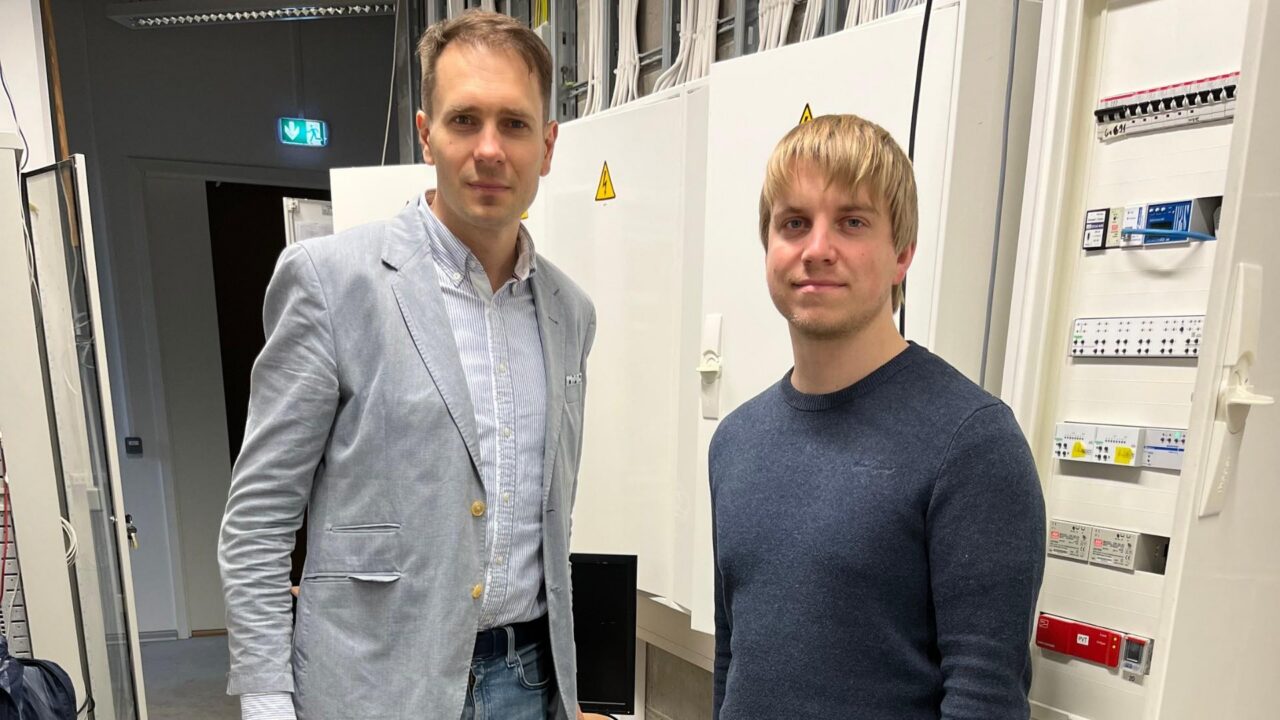
DCR Technologies co-founders Oleksandr Husev and Oleksandr Matiushkin. Private collection
The market is moving towards direct current
According to DCR Technologies, the world is embracing energy systems in which direct current will play a much larger role than before. Husev cited the Netherlands as an example, where relevant DC standards are already being developed. The same direction is also visible in Estonia.
Lind believes customers do not need to wait for the moment when DC networks are adopted more widely – they can already prepare their systems for the transition.
“Customers do not have to bet solely on the moment when DC networks arrive,” Lind said. “They can invest in this today and be ready for the future.”
The technology being developed by the company is based on four patents developed at TalTech. Research funding and grants have played a significant role in DCR Technologies’ growth: the company has secured more than €1 million in research funding, while various support measures and grants account for more than half of its initial financial plan. According to Lind, this makes it possible to develop the technology without giving away too much equity.
DCR Technologies is currently moving from the prototype phase to the pilot-project stage. The first systems are in place, and the next steps are to focus on piloting, expand cooperation with industrial partners and commercialise the technology.
Industry is showing interest
DCR Technologies’ solution is not yet market-ready, but according to the company, the sector is already showing interest. It has received letters of intent from several major companies, including Schneider Electric.
“At this stage, letters of intent are the most important validation,” Lind said. “The product is not yet on sale, but the letters of intent show that the problem exists and that a solution is expected.”
The company plans to involve investors in an investment round at the end of the year, with the aim of bringing the technology to market and expanding its use.
DCR Technologies has been supported, among others, by the Finnish venture capital fund Nordic Science Investments, which focuses on growing research-based companies. Mart Maasik, a partner at the fund, helped shape the model for agreements connected to TalTech and for creating the spin-off, ensuring that both the university and the company retain a long-term interest in developing the technology.
DCR Technologies’ ambition is not merely to adapt existing devices to a new grid logic. The company wants to help shape the next generation of electricity networks – ones in which direct current is no longer an exception, but has become a cornerstone of the energy system.
“Customers do not have to bet solely on the moment when DC networks arrive. They can invest in this today and be ready for the future.”